Learn about the latest organizational culture trends, best practices, and research from the global authority on workplace culture.

The business world may be ever-changing, but one thing remains constant: Organizations that harness the differences of their people are the ones that will excel.
Our Great Place To Work® research has found that when it comes to unlocking innovation, workplace diversity and inclusion is the key. Regardless of industry, field, or domain, organizations that seek diverse viewpoints — across ethnicity, gender, age, educational background, etc. — experience higher rates of innovation.
For example, our research has shown that when employees are uncomfortable sharing personal details, such as sexual orientation or whether they have a disability, those companies see a drop in levels of employee trust, pride, and camaraderie, all of which are critical to effective innovation at work.
Similarly, racially diverse workplaces show higher revenue growth than their less diverse counterparts — 11.1% for those in the top quartile versus 8.6% for those with significant gaps between white and minority employees, based on our research.
But elevating the importance of diversity and inclusion in the workplace is just half of the equation for unleashing your organization’s innovative potential. A deeper, more structural change is needed.
Many leaders associate innovation with experts, technologists, and R&D professionals whose job it is to grow the company. But the truth is that innovation is about people. It’s about the game-changing ideas they can create by coming together in diverse and inclusive teams.
Here’s why diverse and inclusive teams are the new engines of innovation at work:
1. Diverse and inclusive teams create more unconventional ideas
Ideas aren’t created out of thin air. They’re created by people — by teams of people. And the more diverse these teams are along many dimensions (culture, ethnicity, gender, sexuality, age, experience level, educational background, expertise, etc.), the more likely they are to draw inspiration from seemingly unrelated places. These idea combinations lead to more unlikely — and more innovative — ideas.
A striking example of this concept is Wegmans’ cauliflower rice story. In 2014, before the cauliflower craze truly hit mainstream consciousness, Jody Wood, a meal coach at Wegmans, came up with the idea of introducing cauliflower rice as a healthy food option in the store. This initiative was spurred by Wood’s personal journey to find dietary solutions for her husband’s Type 2 diabetes.
The idea was implemented thanks to the inclusive and diverse culture at Wegmans, which values input from all employees, irrespective of their role. Wood’s seemingly simple idea was embraced by the management, tested in the store, and then rolled out across the Wegmans chain after resounding success.
This not only exemplifies the power of diverse ideas in driving innovation but also showcases how an inclusive culture can allow a company to stay ahead of trends.
2. Diverse teams are better at making decisions
When it comes to deciding which ideas to test and put more resources behind, diverse and inclusive teams are far better than homogenous ones.
Data collected by Cloverpop found that the more diverse the team (by gender, geography, and age), the better the team’s decision. James Surowiecki’s book “The Wisdom of Crowds” also supports this idea.
When teams increase their level of difference, they increase their chances of selecting an idea that is game-changing. Why is that? Because diversity of thought stretches a team in ways that can be uncomfortable, but effective.
Diversity of thought also fuels employee trust, which raises employees’ ambition level on what they believe they can accomplish and redefines the parameters that they otherwise operate within.
For example, when we asked employees in the Trust Index™ Survey if there was anything that made their workplace special or unique, one LGBTQ+-identifying respondent said:
“There are a lot of opportunities for growth and variety. My team and I are constantly developing and implementing new ideas and processes, which I feel is intellectually challenging and impactful in a way that no other job I have been a part of has been able to offer me.”
A diverse team of decision-makers can also prevent bad decisions from being made — ones that may alienate customers, harm the brand, or impede growth — simply by including people who think about the landscape differently.
3. Diverse teams are better at making innovative ideas happen
Diverse teams can bring to bear a broad array of experiences, perspectives, skills, and networks. This expansive resource base allows them to execute on ideas more quickly, efficiently, and cost-effectively.
“A diverse team of decision-makers can prevent bad decisions from being made — ones that may alienate customers, harm the brand, or impede growth.”
Consider the experience of one Disney Park that collaborated with the broader Medici Group. In this instance, the park didn’t operate in isolation; instead, it tapped into the resources, knowledge, and experiences of other Disney parks and divisions. This collaboration embodies the power of diverse teams, demonstrating how leveraging a wide range of internal resources can drastically improve operational efficiency.
Prior to this cross-collaboration, it would take 40 weeks for this park to bring an idea to fruition. After incorporating insights and strategies from a diverse set of teams across various Disney divisions, the time to execute on an idea was reduced to just 6 weeks.
This outcome not only improved the park’s operational efficiency but also enhanced its ability to innovate and adapt to changing market demands.
By promoting expansive, serendipitous collaboration, organizations can drive fast action and keep pace with the rapidly evolving business landscape. Hence, diversity doesn’t just evolve new ideas; it provides the pathways and accelerates the pace to execute these ideas efficiently and effectively.
How to bring the “diversity drives innovation” mentality to your organization
By now, it may strike you that diverse and inclusive teams are like idea factories — they’re literally built for innovation at work. But what does this mean for you and your organization?
There are three things you can do right now to create a culture of innovation:
1. Seek others’ perspectives
Innovation requires creating many ideas and selecting the best ones. By doing something as simple as including people with different viewpoints in your meetings, you’ll likely get inspiration you’d never think of on your own.
2. Be wary of the word “expertise”
Remember that experts aren’t always the ones with the right or best answers. In fact, the shelf-life of “expertise” is expiring more rapidly every day. Open yourself to the possibility that anyone, anywhere, can catalyze your company’s next big idea.
Embracing this mindset is not only empowering for all employees but also fosters an environment where innovative thinking is truly democratized. As one young LGBTQ+-identifying employee insightfully shared in our company culture survey:
“The work culture is one that supports the mantra, ‘The best idea at the table wins’.
“Though I am a new, young employee, I feel like I have agency and autonomy, and my contributions are considered equally valid to those of my peers who have been here for years.”
3. Encourage employees to bring their whole selves to work
Every individual has a wealth of experiences, interests, and passions to draw on. Create a company culture that celebrates and uses them. These different opinions and insights could send a conversation down a path toward creating something truly unlikely and unexpected!
4. Foster psychological safety
When you have a diverse and inclusive workplace, you can unleash an explosion of ideas. But hiring a diverse workforce isn’t enough. Employees from every group need to feel psychologically safe to bring their unique perspectives forward.
The concept of psychological safety, first introduced by Harvard Business School professor Amy Edmondson, means creating a workplace where employees feel safe to take risks, voice their opinions, and admit mistakes without fear of punishment or judgment.
When individuals feel psychologically safe, they’re more likely to share unique ideas and perspectives, which can spark innovation. It also ensures that the diverse voices within your organization are not just present, but are heard and valued. This atmosphere of trust and openness is crucial for diversity to effectively drive innovation.
So, don’t let titles or years of experience restrict the flow of ideas in your organization. Today’s dynamic and rapidly evolving business landscape demands fresh perspectives, and sometimes the most ground-breaking ideas come from the least expected sources.
Diversity in the workplace drives innovation
Ready to tap into the potential of diversity and drive innovation in your organization? Don’t wait. The Great Place To Work Trust Index Survey, featuring the unique Innovation Velocity Ratio, is designed to assess and elevate inclusion and innovative practices in your workplace.
This isn’t just about today. It’s about preparing for a successful future, built on the rich diversity of your team. Join the ranks of forward-thinking organizations by getting started with the Trust Index Survey today. The time for inclusive innovation is now.
Every employee should take these behaviors to heart whether or not they are people leaders.
I often get asked what it takes to create a great workplace. The short answer: trust.
High-trust cultures help employees thrive, which fuels company performance in all areas — from referrals and retention to productivity and revenue.
It’s impossible to create a great workplace for all employees without trust. That’s what our 30 years of research about company culture has told us. And that’s why our survey that measures employee experience is called the Trust Index™.
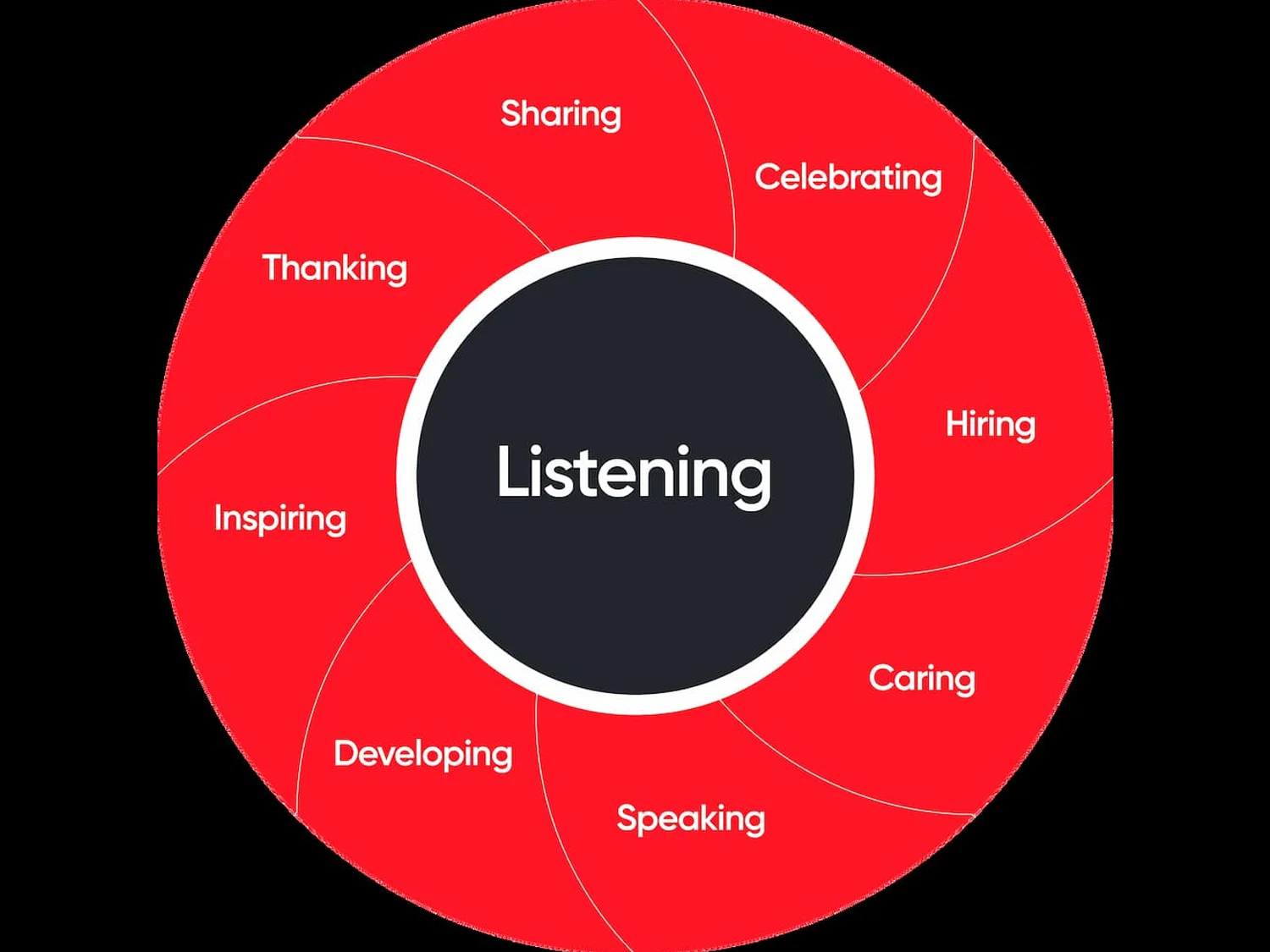
Trust is woven into our daily interactions at work, just as it is outside of work among family and friends. It’s built on many moments — moments that our research has broken down into nine behaviors that can build or break trust. It’s a list I keep on my desk and check every day check-in on how I’m doing as a leader.
Every leader should work on and improve these behaviors; if you’re not a people leader, you might be thinking, “What does this have to do with me?”
Leaders affect 70% of the employee experience, but the other 30% comes from our teammates, how we work with others, and the actual work that we’re doing. It takes everyone in an organization to create a great workplace for all.
Here’s where to begin:
1. Listening
This is the most important behavior of all and what I focus on the most. If you’re not a great listener, you can’t model the other behaviors well.
Listening is not just making sure you’ve accurately heard the words coming out of someone’s mouth. It’s also not just waiting for someone to stop talking so you can speak. It is choosing to empty your mind and set aside your opinions while someone else is talking.
True listening requires humility, vulnerability, and empathy.
You may have a lot of opinions, but to be a for-all, inclusive leader, you must put those opinions aside. If you’re having a conversation and you’re not willing to consider other points of view, what’s the point of having the conversation at all? Letting go of your assumptions can be described as a meditative mindset, and that’s what makes a great listener.
How do you know you’re doing it right? You’ll find yourself asking questions because you’re learning something from the person you’re talking to. People will tell you that you’re a great listener because it’s rare to have a conversation with someone who’s deeply listening.
Listening might sound reactive, but it should be proactive. Make yourself available and seek out chances to listen.
Think about who you haven’t heard from lately — and then go ask them questions with a learning mindset. Schedule informal meetings like brown-bag lunches and Q&A sessions. Use surveys and focus groups to regularly elicit employee opinions — and follow up with feedback and action.
"Listening is not just making sure you’ve accurately heard the words coming out of someone’s mouth. It’s also not just waiting for someone to stop talking so you can speak. It is choosing to empty your mind and set aside your opinions while someone else is talking."
2. Speaking
This is what we do all day. But there are many layers to what might seem like a straight-forward behavior.
Speaking is about clarity, frequency, transparency, and sharing information fully in a variety of ways. That includes regularly sharing company news with employees through all your channels — video, intranet, email, print, etc. Be sure to share that news (both the facts and feelings around it) internally before you do externally.
It’s not just about what you share, but who you share it with. Be mindful of those who haven’t heard a message and need to know what information is being shared.
Speaking is more than what you say and who you say it to, it is how you share information. Communicate thoughtfully and with care, and in easy-to-understand styles. Set up regular meetings to discuss what’s happening and personally share news to encourage a culture of transparency as much as possible.
Lastly, speaking is an opportunity to communicate how a person’s job — and how doing their job well — is essential for your organization to achieve its purpose.
Consider your receptionist, for example — a role that is often overlooked. Whenever you speak with them, reiterate, emphasize, and clarify how important their job is. When someone walks in a building or contacts a receptionist on the phone, that’s a connection to the brand. In a few seconds, a caller or visitor either feels cared for, important, and listened to, or they don't.
Speaking is the ability to talk to every warehouse worker, every receptionist, every salesperson, every executive, every teammate in a way that they feel that doing their job is important for the organization to achieve its purpose. And if you’re not sure what someone does, this is your opportunity to build trust by getting to know them.
"Speaking is more than what you say and who you say it to, it is how you share information."
3. Thanking
If you’re listening to people in the way that I described earlier, you’ll learn things about them. That helps you thank your colleagues in ways that are personally meaningful. Acts of gratitude let people know you’re listening in a way that shows they’re important and essential.
Create a culture of appreciation by recognizing good work and extra effort frequently.
Opportunities to do this are endless: Encourage peer recognition, present employee awards, write personal notes, appreciate mistakes as learning opportunities, and recognize employees who demonstrate company values in person and in front of others.
Creating a culture of thanking will positively affect people’s sense of value and willingness to do their best work because they feel seen.
4. Developing
Listening and speaking helps you learn how someone can further develop personally and professionally.
It’s your job to help employees grow as people, not just performers. Nurture their talents and interests through courses (job- and non-job-related), tuition reimbursement, and personalized development plans and training, for example. Connect employees with mentors and inform them of internal job postings.
Try and give feedback in a way that’s measurable, so they know they’re improving, and with a sense of care, so they’re open to what you have to say.
When people know you care — even if they don’t always like hearing where they need to improve — they’ll take it as a gift. Everybody wants to get better. Yes, they know it leads to more money, more compensation, and more responsibility in the company. But, at a base level, they want to know they’re making a difference.
"It’s your job to help employees grow as people, not just performers."
5. Caring
This is the secret weapon. Great work happens when people care. And people care about their work when they experience being cared for. That shows up when you take time to understand and listen to people’s experiences, inside and outside of work.
Support their personal lives by discussing options for flextime and personal leave policies. Help them cope with family and personal crises as they arise, and organize support through sick leave or monetary donations. Encourage work-life balance and remind them to take time off to recharge.
Do you know what makes an employee check an algorithm two or three times, or proofread an email six or seven times? It’s because they care about the purpose of the organization, they care for others, and they feel cared for.
Caring is what unlocks people, and it is key to maximizing a human’s potential.
"Great work happens when people care. And people care about their work when they experience being cared for."
6. Sharing
Distributing profits, compensation, bonuses, and incentive plans fairly creates an equitable workplace. If you’re building trust for all, every employee needs to share in the company’s success and understanding how their performance relates to compensation.
Equitable and inclusive sharing also shows up in philanthropic activities. If you’re organizing community activities like a cleanup at a local school, or picking up plastic off a beach or park, make sure that everybody has the opportunity to participate.
If you’re doing those things between eight to five, what about the night shift worker? Make sure you’re truly inclusive in terms of sharing opportunities for people, as well as the resources of the organization.
Equity does not equal sameness. A picnic for the day shift doesn’t also have to be a picnic for the night shift. What is the purpose of the picnic? To bring people together, to show them their value, and create opportunities for them to interact in informal ways with their leaders.
So how can you create this same experience for this night shift without recreating the same event?
7. Celebrating
The most important things to celebrate are the values of the organization and how people help the organization achieve its purpose.
It’s important to be specific:
“We want to thank John for the work he did in helping a customer through a sticky problem. We wanted John to do that in seven minutes, but John took 20 minutes because the customer needed it at that time. At our company, we’re willing to do whatever is required to make the customer’s problem our problem, and we’re willing to do what’s required to solve it. I also know that John was late for getting to a soccer practice for his kid. I hope John doesn't have to do that again, but I want to appreciate the fact that he did that for us.”
If you find yourself celebrating, recognizing, and rewarding the same person, communicate to everyone what it takes to be celebrated and recognized so they don’t feel there’s bias or favoritism. They’ll know if they work hard in some measurable way, they too will get celebrated, recognized, and rewarded one day.
"The most important things to celebrate are the values of the organization and how people help the organization achieve its purpose."
8. Inspiring
You don’t have to be a great public speaker to inspire people. You can inspire people with the questions you ask and the way you listen.
You can inspire them by reaffirming the difference your organization makes in the world and why the work is important. Help your workforce understand how their work relates to the company’s higher purpose and business success.
You can do this by telling customer or client stories, sharing the vision of where the company is headed, pointing out behaviors that exemplify company values, reinforcing company values, stressing your company’s contribution to your industry or society, and showing links between employee efforts and achieving your goals.
"You don’t have to be a great public speaker to inspire people. You can inspire people with the questions you ask and the way you listen."
9. Hiring and welcoming
When someone joins your organization, you should make sure that they know you were expecting them — and that you couldn’t wait for them to get here.
You need to make sure that they have a workplace, can access the systems they need to connect with their work and their colleagues, and have the equipment to be successful. Their laptop is ready, their uniform is ready, their steel-toed boots are ready, their safety goggles are ready.
This goes beyond hiring; it’s what we call welcoming. You can email or send new hires a note in the mail before they start, announce them to other employees in advance, take them to lunch their first week, and help them get integrated into your culture.
When a person joins an organization that has shown that they’ve been thinking about them for a few weeks before they started, they will go home and say, “It was a great experience today. They expected me, my name badge was ready. Everybody was kind, and they seemed to know who I was and what I was going to do.” These actions build trust on their first day.
If someone gets to work and those things aren’t true, trust dips a bit. Self-confidence drops. They wonder if you really want them there, or if they’re an afterthought.
And the worst case — they feel like they’re just an employee and not a person who’s important, because if they were important, they would’ve had a much different experience when they arrived.
Whether or not you manage people at work, I encourage you to put this wheel of nine high-trust behaviors in a place where you will see it every day.
Trust takes work and conscious effort. And it’s required to create a great place to work for all.
Become great
Ready to learn more about your employee experience? Benchmark your organization using Certification™ and see how you stack against the very best.

Parental leave, work-life balance, and meaningful work engage working parents and drive high retention rates.
There’s a lot of joy when you become a parent, but the stress of taking time off weighs on many new moms and dads.
Many don’t have access to paid leave.
Some U.S. employees are eligible to receive up to 12 weeks of unpaid leave through the Family and Medical Leave Act (FMLA), but the U.S. is the only wealthy country in the world that doesn’t mandate paid parental leave, according to the Organization for Economic Cooperation and Development (OECD). (In comparison, Estonians get 80 weeks.)
The ability to take time off without having to rush back for a paycheck is eased for parents at the 2022 Best Workplaces for Parents™ where paid paternal leave is 16 weeks on average for new moms, and nearly 12 weeks for new dads. Great Place To Work determined this year’s list by analyzing data from more than half a million employees with parenting responsibilities.
Paid leave not only helps working parents enjoy time off with their newborns, but drives retention.
Nearly nine out of 10 parents at the Best Workplaces for Parents say their company has “special and unique benefits,” and when that’s true, they’re 65% more likely to stay with their employer.
A staggering 91% of parents at these companies want to work at their companies for a long time. That’s a far cry from the 55% of parents at a typical U.S. workplace who are open to changing jobs by the end of this year, according to a July Great Place To Work survey of nearly 4,200 workers.
But offering paid paternity leave alone isn’t a silver bullet for retention.
“What sets these companies apart is they have cultures that allow new parents to take paid leave without fear—fear of losing their job, fear of missing out on a promotion, fear of getting left behind,” says Michael C. Bush, CEO of Great Place To Work. “Offering time off in cultures where it can’t really get taken erodes trust.”
These cultures also provide employee well-being support. More than 90% of parents at Best Workplaces say they’re encouraged to balance their work and personal lives.
“Offering paid time off for parents is a good start, but what’s their day-to-day experience like when they’re back at work? Can they make it to their kid’s soccer practice and still get promoted down the line? The answer should be ‘yes,’” Bush says.
Couple time off and employee wellness support with meaningful work, and you’ve created a workplace that will attract and retain parents.
Here’s what the research tells us:
1. Expand special and unique benefits, such as paid leave.
Nearly nine out of 10 parents at the Best Workplaces for Parents say their company has “special and unique benefits,” and when that’s true, they’re 65% more likely to stay with their employer.
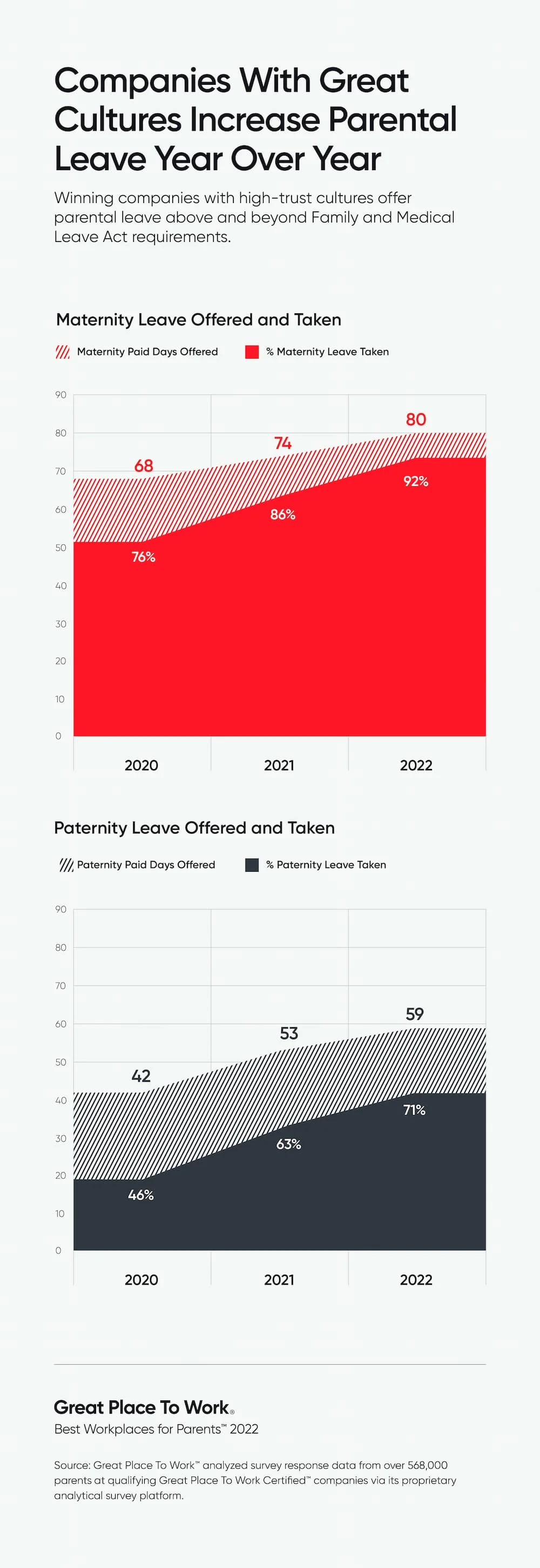
Since 2020, these workplaces have steadily increased paid parental leave (by 12 days for moms and 17 days for dads over the three-year span) while other companies have cut leave time.
Great workplaces offer cultures where new parents can take that time. More than 90% of moms and 70% of dads take the paternity leave their companies offer.
“I made the move to Toast last month from a different company and was pleasantly shocked at the benefits package. I re-read it a few times to make sure I was actually reading and seeing it correctly,” said an employee at Toast, ranked No. 21 among large companies. “A lot of companies say today that they support parents but their PTO policies and benefit packages don't actually align with that statement.”
In addition to extending paid leave beyond FMLA requirements, great workplaces for parents offer financial assistance around fertility needs and support nontraditional families.
“When PMG leadership found out I was becoming a foster parent, they enacted foster care parental leave immediately and still are the only company I have heard of to have such a benefit. Just one example, but [the] underlying understanding that PMG as a business has — that in order for us to be successful, the people have to be seen and supported — is one that permeates our culture,” said an employee at PMG, ranked No. 24 among small and medium-sized companies.
“Offering paid time off for parents is a good start, but what’s their day-to-day experience like when they’re back at work? Can they make it to their kid’s soccer practice and still get promoted down the line? The answer should be ‘yes.’” - Michael C. Bush, CEO, Great Place To Work
2. Offer work-life balance support.
One in four working parents suffer from burn out, according to a joint Maven/Great Place To Work study. This burn-out contributed to millions of parents to leave the workforce during the height of the pandemic. Many had to choose between their jobs and taking care of their children.
High burnout levels show no sign of slowing down, making work-life support a key retention driver for parents. Great workplaces understand that parents might want to walk out the door if they have to skip yet another daytime school play, sports game for a work meeting.
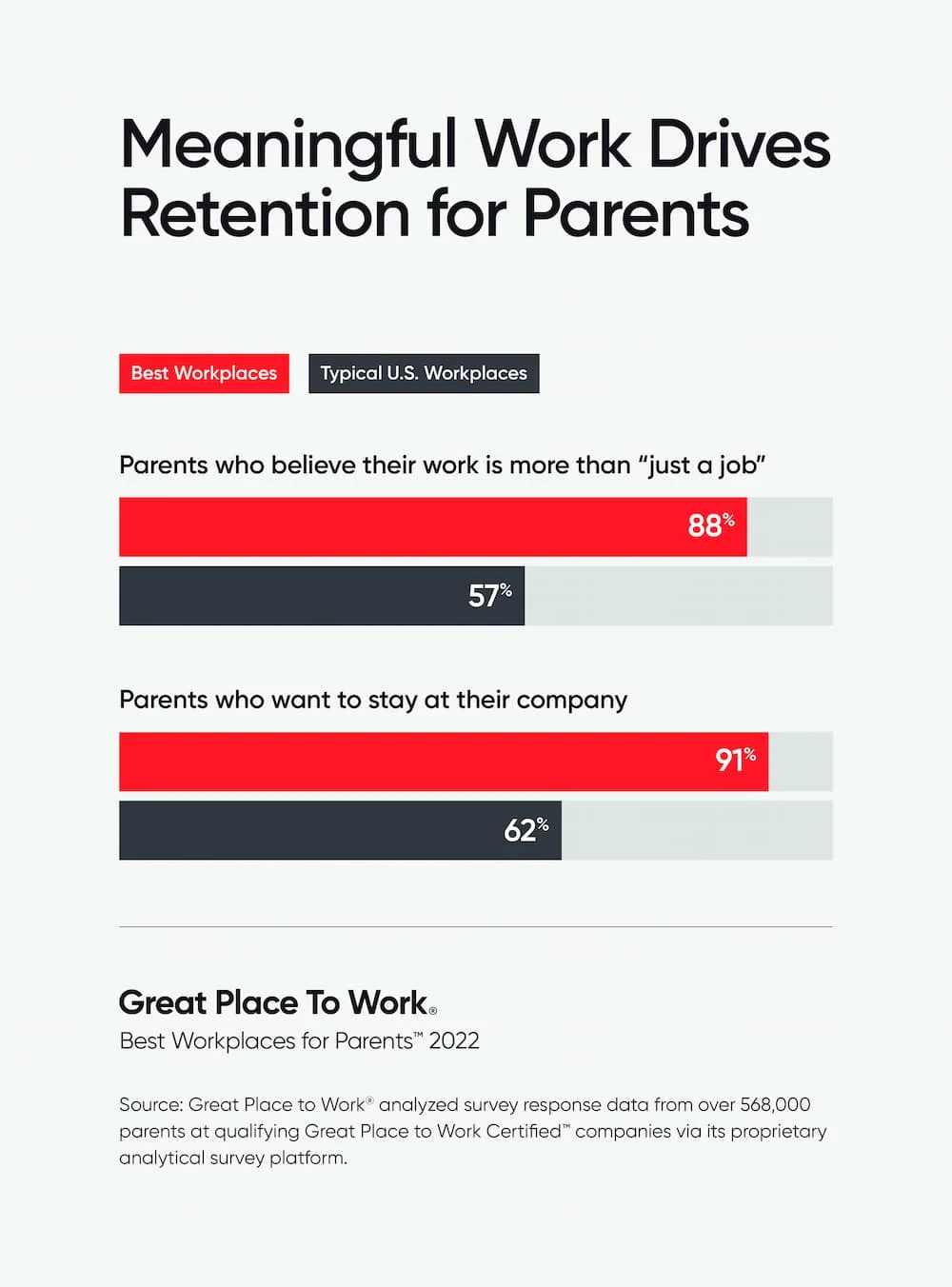
Parents are nearly 40% more likely to feel their company is a great place to work if they believe people are encouraged to have a healthy work-life balance. And 91% of parents at these winning workplaces believe their companies support that balance compared with 62% at a typical workplace.
“My boss always allows me to be at events for my children,” said an employee at Baird, ranked No. 45 among large companies. “They always support my family and never make me feel guilty or bad for needing to take off for events with my children. I'm never afraid to ask my boss.”
But it’s not just parents who feel supported at these companies. If you create a culture where you’re communicating respect for people’s lives outside work, it’s good for everyone, regardless if an employee is a parent.
At these workplaces, when nonparents feel they’re encouraged to balance their work and personal lives, they’re 48% more likely to say their employer is a great place to work and they’re 39% more likely to stay with their companies for a long time.
3. Connect meaning to work.
All employers should prioritize connecting what their employees do with the organization’s greater purpose.
It’s not only that the top retention driver for parents is purpose at work, it is also a key predictor of employee attrition for all workers. (Download our Power of Purpose at Work report today.)
Parents at a typical workplace experience less meaning at their jobs — 57% — compared with 88% at the Best Workplaces for Parents, which has a large impact on retention.
There is a three-fold increase in the odds that a parent will stay with their company if they believe their work has special meaning and is more than “just a job.”
Show working parents that they — and all employees — matter. It's what we want in our lives, both inside and outside of work.
Interested in making a Best Workplace list?
Find out how and apply to this or other Best Workplaces lists.
CREDIT: Roula Amire

Every individual has the capacity to develop a high-performance mindset notwithstanding experience, age, gender, ethnicity, or social economic status. A high-performance mindset is an approach and perception one has towards a circumstance or a task.
The high-performance mindset is not reserved for intellectually gifted or athletic individuals and it is not just about winning, being “the best,” or getting world-class results. It’s about the ability to create the most improved internal capability of being the best. A high-performance mindset is all-encompassing; it is authentic and personal while equally being optimal for a specific circumstance.
To develop a high-performance mindset, one will need to invest in psychological principles which include mindfulness, self-discovery, and mental skills. These principles help in creating self-awareness, and they have a huge influence on thoughts, words, and actions which will support expression that is independent of an individual’s chosen craft or profession.
The repetition and consistency of intentional thoughts turn into thought patterns and the patterns of thought consequently influence how one sees the world; thinks about oneself, what is possible of happening in life, the approach to disappointments, failures successes; and even the quality of relationships.
The High-Performance Mindset helps in realigning and resetting the conscious mind to eliminate the unproductive thoughts, beliefs, and “self-talk” that prevent one from being and doing one’s absolute best . More than inspiring words and positive affirmations, it provides concrete, proven mindset modification techniques to sharpen focus, boost confidence, and shift personal performance into hyperdrive. When individuals learn how to control their thoughts, they become unstoppable since thoughts control their destinies.
Every individual has the capacity to deliver a high-performance mindset notwithstanding experience, age, gender, ethnicity, or socioeconomic status. A high-performance mindset is
an approach and perception one has towards a circumstance or a task. It is characterized by a strong focus, determination, and commitment to achieving exceptional results or performance in a particular domain. It involves cultivating a set of beliefs, habits, and strategies that optimize personal and professional growth, productivity, and success.
The high-performance mindset is not reserved for intellectually gifted or athletic individuals, and it is not just about winning, being “the best,” or getting world-class results.
It’s about the ability to create the most improved internal capability of being the best. A high-performance mindset is all-encompassing; it is authentic and personal while equally being optimal for specific circumstances.
To develop a high-performance mindset, one will need to invest in psychological principles which include mindfulness, self-discovery, and mental skills. These principles help in creating lifelong survival skills.
Key elements of a high-performance mindset:
- Clear Goals: Having well-defined, specific, and challenging goals is essential for maintaining focus and motivation, which leads to High Performance. High performers set goals for themselves, their Team, and even the organization that stretch their abilities and provide a clear direction for their efforts.
- Growth Mindset: Embracing a growth mindset means believing in the capacity for continuous learning and improvement. High performers see failures and setbacks as opportunities for learning and experiencing new things, this positively impacts growth and development. It makes individuals see daunting tasks from a positive perspective or turn negativity into limitless outcomes rather than viewing them as obstacles.
- Resilience: High performers understand that setbacks and obstacles are a part of the journey toward building success stories. They possess and harness Mental resilience to bounce back from failures, losses, setbacks, and delays, they maintain a positive attitude and persevere in the face of challenges.
- Discipline and consistency: Consistently taking disciplined actions and following through on commitments is crucial for high performance. High performers prioritize their tasks, manage their time effectively, and maintain a consistent work ethic.
- Focus and concentration: Maintaining a high level of focus and concentration is essential for maximizing productivity and performance. High performers eliminate distractions, prioritize their tasks, and engage in deep work to achieve their goals.
- Continuous improvement: High performers are constantly seeking ways to improve their skills, knowledge, and performance. They update their knowledge and hone their skills to excel through experience and expertise over a specific period. They embrace feedback, actively seek new learning opportunities, and strive for incremental progress.
- Positive mindset: Adopting an optimistic mindset helps high performers overcome challenges, maintain motivation, and stay resilient. They focus on possibilities rather than limitations and cultivate a positive internal dialogue.
- Time management: Effective time management is highly important for High performers. They prioritize their tasks, set deadlines, and allocate their time wisely to ensure they are investing their efforts in the most valuable activities. They eliminate or delegate activities that are not value adding
- Self-care and well-being: Regular daily attention to grooming, and taking care of physical and mental well-being is crucial for sustaining high performance. High performers prioritize sleep, exercise, healthy eating, relaxation, rest, and other self-care practices to maintain their energy, focus, and overall well-being. This prevents burnout and enhances performance
- Accountability and responsibility: High performers take ownership of their actions, results, and decisions. They hold themselves accountable, take responsibility for their successes and failures, they avoid blaming external factors
The high-performance mindset is a skill that can be developed and cultivated over time through consistent practice and deliberate efforts and productive activities. By adopting these principles and incorporating them into individual daily life, and including them as part of the organization’s culture, individuals can enhance their performance, and achieve goals effectively over a long time. It must be consistently reviewed to curb deviation and encourage innovation in workplaces.

Dynamic Teams are the bane of an effective workforce. To promote fair treatment and full participation, and foster diversity, equity, and inclusion (DEI), it is critical to have a framework to foster a positive and productive work environment.
Diversity, equity, and inclusion are mutually inclusive values adopted by progressive organisations globally aimed toward providing support to groups of individuals, across diverse races, ethnicities, religions, abilities, genders, and sexual orientations.
Diversity, Equity, and Inclusion (DEI) has its origin in various social justice movements, and efforts to address systemic inequalities in the society. It is important to provide a background to how these values became core to the success of organisations.
Diversity: The concept of diversity emerged in the 1960s during the civil rights movement in the United States. It sought to challenge discrimination based on race, ethnicity, gender, and other protected characteristics. The movement aimed to create equal opportunities and fair treatment for individuals from diverse backgrounds.
Equity: is focused on fairness and justice, by recognizing that individuals and groups have different needs and starting points. It emerged as a response to the limitations of equality, which assumes that treating everyone the same will lead to fairness. Equity, however, recognizes that individuals may require different levels of support or resources to reach an equal outcome.
Inclusion: Inclusion is rooted in the idea that diversity alone is not adequate; it is essential to create environments, where everyone feels welcome, respected, has a voice, and feel valued. The concept gained prominence in the 1990s with the rise of inclusive education and workplaces. The aim is to foster a sense of belonging. and ensure that individuals from diverse backgrounds can fully participate and thrive. Wherever they find themselves.
DEI has evolved over time, influenced by civil rights, feminist, disability rights movements, advocacy, and other social justice initiatives. The term "Diversity, Equity, and Inclusion" became more widely used in organizational and institutional contexts as a framework for addressing systemic inequalities and promoting equality and fairness for all individuals.
Currently, many groups, including businesses, educational institutions, nonprofits, and government agencies are embracing DEI, as a means to foster inclusive environments, reduce bias and discrimination, and leverage the benefits of diverse perspectives and experiences while creating an attractive environment for job seekers.
It continues to evolve as a dynamic field with ongoing efforts to dismantle systemic barriers and promote social justice.
It has been predicted that by the year 2025, the workforce has been estimated to consist of 75% millennials, which will continue to be another driving force for DE&I. This segment of the workforce places a high priority on diversity, with a 2016 survey reporting that 47% of millennials actively look for diversity in the workplace, meaning that diversity should also be a primary concern for organizations looking to attract the best and brightest employees.
These are some recommendations to improve Diversity, Equity, and Inclusion:
1. Unconscious Bias Awareness and Management: Act swiftly and decisively when instances of bias or discrimination occur. Investigate complaints thoroughly and impartially and take appropriate and decisive actions to resolve the issue. Continuously communicate a zero-tolerance policy for discrimination, and harassment of any type and ensure all team members are aware of the avenues for reporting concerns. Stay updated on current research and best practices in DEI. This will help you approach team management with a well-informed perspective.
2. Promote Pay Equity: There should be no discrimination in all aspects including pay. If a team is receiving a specified amount or bonus, it should cut across everyone in that level regardless of age, race, background, gender, etc. This will encourage great performance.
3. Develop a Strategic Training Program: Organize strategic training to promote Diversity, Equity, and Inclusion in the workplace. These trainings will enhance awareness and understanding among team members. This can include workshops, webinars, or seminars on unconscious bias, inclusive leadership, cultural competence and intelligence, and mitigating discrimination. Professional development in these areas should be encouraged in organisations.
4. Establish Inclusive Policies and Practices: Review existing policies, procedures, and practices to identify any biases, or barriers that may hinder inclusivity. Make necessary adjustments to ensure equal opportunities for all team members. This may include flexible work arrangements, accommodation for diverse needs, and inclusive language in all communications.
5. Measure and Evaluate Progress: Set measurable goals and regularly assess progress in creating an inclusive team. Use metrics such as diversity representation, employee satisfaction surveys, and retention rates to track progress. These metrics strategies and initiatives can be adjusted based on feedback and results from employees.
The importance of diversity and inclusion in an organisation is the crux to maximizing operations. The benefits include an inclusive atmosphere that will help attract a diverse group of employees, which can be leveraged to brainstorm new ideas for the company across all spectrums and propel the company to greater heights.