Learn about the latest organizational culture trends, best practices, and research from the global authority on workplace culture.

The success of any company is largely determined by the quality of talents embedded in the organisation. Organisations seeking success in a hyper-competitive and increasingly complex global economy must devise a strategy to attract and retain the best talents available in its operating landscape.
The recruitment and retention strategy must be top priority to thrive in an industry. Having a great vision and well-designed strategies will not be sufficient, without the right people in the right seats doing the right things; if care is not taken, a company can have the right people in the wrong seat, hence it is important to recognize talents.
The best organisations worldwide ensure that they have the right people for the job even before coming up with strategies. In their list of priorities, the “who “comes before the “what”. The future is entirely unpredictable, which has been proven by several occurrences like the Covid 19 global pandemic, economic recession, soaring oil prices, costs of living standards, inflation etc.
As organisations are confronted with chaos, and uncertainty, the best strategy is to have a team of excellent talents that demonstrate proven achievements, be ready to take ownership of their roles and deliver the targets of the company. These people should easily adapt to any situation, and thrive, regardless of what comes next. However, most companies struggle to attract and retain top talent, because they are ill-equipped to deal with it.
The best way to attract and retain top talents is to create a culture and environment that appeals to them. An employer brand might be impeccable as people perceive the company and its values positively. Ultimately, the culture and environment that has been created, modified, and refined within the organisation will keep employees.
Attracting and retaining top talents is a critical aspect of building a successful organization. Here are some strategies that can be adopted to be a preferred employer:
- Build a Strong Employer Brand: Establish a positive employer brand that showcases company culture, values, and mission. Use social media platforms to communicate the brand message, showcase the work culture, and employee experiences.
- Competitive Compensation and Benefits: Offer competitive compensation and benefits packages that are aligned with industry standards or even more. This helps to attract top talents, retain them, and bridge remuneration gap that may exist.
- Professional Development Opportunities: Another way to retain top talents is to invest in coaching and training. Grow teams that will reach its potential and surpass targets. If some of the team members are not performing well, it is important to find out why and use corrective approaches to enhance teams’ performance. Furthermore, offer opportunities for employees to learn and grow professionally, provide training programs, mentorship opportunities, and career advancement opportunities.
- Positive Work Environment: When deliberate actions are taken to create a positive and inclusive work environment, this would foster a sense of belonging, encourage collaboration and employee feedback.
- Recognize and Reward Performance: It is imperative to acknowledge, appreciate and reward employees who perform well. There should be implementation of an effective performance management system that includes regular feedback, and recognition. Promoting high performing employees to more senior positions, sends a positive message across the organisation, that their hard work is valued, and will be rewarded.
- Flexible Work Arrangements: Offer flexible work arrangements such as remote work, flexible schedules, and part-time work. This helps to attract and retain top talents who value work-life balance.
- Employee Wellness Programs: Implement employee wellness programs that promote physical and mental health. This helps to improve employee productivity, engagement and retention.
By implementing these strategies, a high performing organisation can attract and retain top talents, create a positive work environment, achieve excellent results and organic growth which will support overall organisational success.

The great talents of the 21st century workplace is not just particular about an Employer Brand, as professionals pursue their career aspirations, the reputation of a company is as important as the job search process itself. Companies who have built strong and sustainable brand top the list of workplaces individuals like to work with.
Employer Branding is a company’s outward message about the company’s leadership, values and culture, it is a communication approach targeted to retain high performing employees, and attract top-raking talent with the purpose of getting employees on board with the vision, mission, values and through telling a compelling story of the organization, it centers on creating a positive workspace where people actually want to work and love their work . Another name for employer branding is Corporate Branding.
From the recruitment to the retention efforts, every action leaves an impression with candidates and employees that shape their opinion of an organization, positively or negatively. Employees and potential candidates are constantly checking out the ratings of a workplace on worksites or social media. Some individuals will solely work with an organization based on what the media or personal reputation such company has.
A great employer branding strategy can help companies attract better talent, cut down on hiring costs, and reduce employee turnover.
Benefits of Strong and Sustainable Employer Branding.
Employees have access to million opportunities across the country, The current workforce is fluid as talents are becoming more agile without sticking with one company for the long haul, therefore, attracting and retaining top talents is needed for an organization to thrive.
Allure top talents
People want to work for an organization whose value aligns with the staff welfare, and one with a good reputation. In today’s world employees are willing to leave a high paying negative work environment for a less paying one that has a positive work environment.
Reduce time and cost per hire
A strong employer brand will give room for an influx of talents even if there is no open role to fill, talents will keep sending in their CVs to pitch, so there are candidates to vet early, a CV databank to interview from, rather than starting the process from attracting new applicants. Also, there will be referrals from outsiders and insiders when there is a vacant role to fill when the employer has a great brand.
Improves Employee Retention
Employees value a healthy work environment and are willing to stay. A low turnout is a great sign of a strong employer brand. Investing in employees’ welfare and brand reputation is well worth it in the long run.
Build credibility with customers and stakeholders
Consumers and clients will trust a company’s services if there is great service rendered by the employees. Having the best team with the right attitude to work will affect business positively. According to Zeno’s 2020 strength of purpose study, 80% of consumer buys from recommended companies they trust.
Boost employees morale
There is pride that comes with working for a great company, employees value companies that carefully consider Staff Welfare and Wellbeing.
How to build a strong and sustainable Employer Brand
The importance of a good employer brand cannot be overemphasized, the very first step is to be a good employer with the right values. Employer branding is something that an organisation needs to continuously manage. Some of the steps towards building a successful employer branding strategy are:
Define your company’s core value.
Core values help companies become outstanding from their competitors, having a clear value, mission, vision, and culture is important to attract and retain talents and must be consistent in practice, as it is in the document.
Design a sustainable and inclusive hiring process.
The hiring process should be inclusive regardless of applicant’s background, it is also important to understand the recruitment and hiring process as well as its challenges. Defining and understanding your candidate personas is a great start while ensuring that the recruitment process is merit driven .
Build a strong online presence.
The world is a digital place, most prospective employees have access to internet and research potential future employers. Optimizing different online channels to promote employer brand and get in front of their candidates’ personas.
Engage your employees.
Employer branding starts from within, engage your existing employees and promote a positive work environment, encouraging employees to share their view about the organisation’s brand will promote it and attract jobseekers and customers.
Measure the success of your Employer branding.
To measure the success of employer branding you must refer to the organisation’s stated goals and objectives and ensure that the outcome tallies with it. Employer brand can positively or negatively impact revenue.
Employees also have a role to play in giving you brand visibility, they are the most important employer brand ambassadors, and employees’ voice is more credible than the CEO’s when it comes to talking about a company’s working condition. Travis Wright posits “No matter how often your PR team is out there sharing the gospel, or the CEO is on television…nothing is more effective than the voice of your employees”.
In conclusion, all hands must be on deck towards building and sustaining an Employer Brand, the company must constantly check and review aspects of Employer branding they would continue or discontinue to remain a great Employer brand.
Regardless of what stage your organization is at on the workplace culture journey, we invite you to consider how to tell the story of your journey through the experiences of your employees.
Want to get recognized for your company culture and build a better employer brand?
Learn about how to get Great Place To Work-Certified.

A culture of recognition develops engaged and loyal employees. Making employee appreciation integral to your workplace culture can be achieved through meaningful and intentional practices.
Employee recognition has long been a cornerstone of effective management. But today, as the competition for talent escalates, the ways organizations show that they value their employees have become more important than ever.
Creating a recognition program is a start—so if you don’t have one, that’s a good first step!—but great companies go further, constantly reevaluating the ways they reward employees. As companies grow, this becomes even more of a challenge, and leaders must rethink the way they add value to the employee recognition experience.
What is employee recognition?
Employee recognition refers to all the ways an organization shows its appreciation for employees’ contributions. It can take many forms and may or may not involve monetary compensation. Companies recognize employees for things like:
- Achievements
- Exhibiting desired behaviors
- Going above and beyond expectations
- Milestones such as tenure
Why employee recognition matters
From a very early age, we crave recognition from parents, teachers and friends. So strong is our desire for positive affirmation, particularly during developmental periods, that we can even perceive a neutral reaction as a negative one.
This continues to hold true as we move into the workplace. Employee recognition helps to:
- Retain top talent
- Increase employee engagement
- Encourage high performance
Great Place To Work-Certified™ company O.C. Tanner studied employee engagement and how managers can tailor their workplaces to promote it.
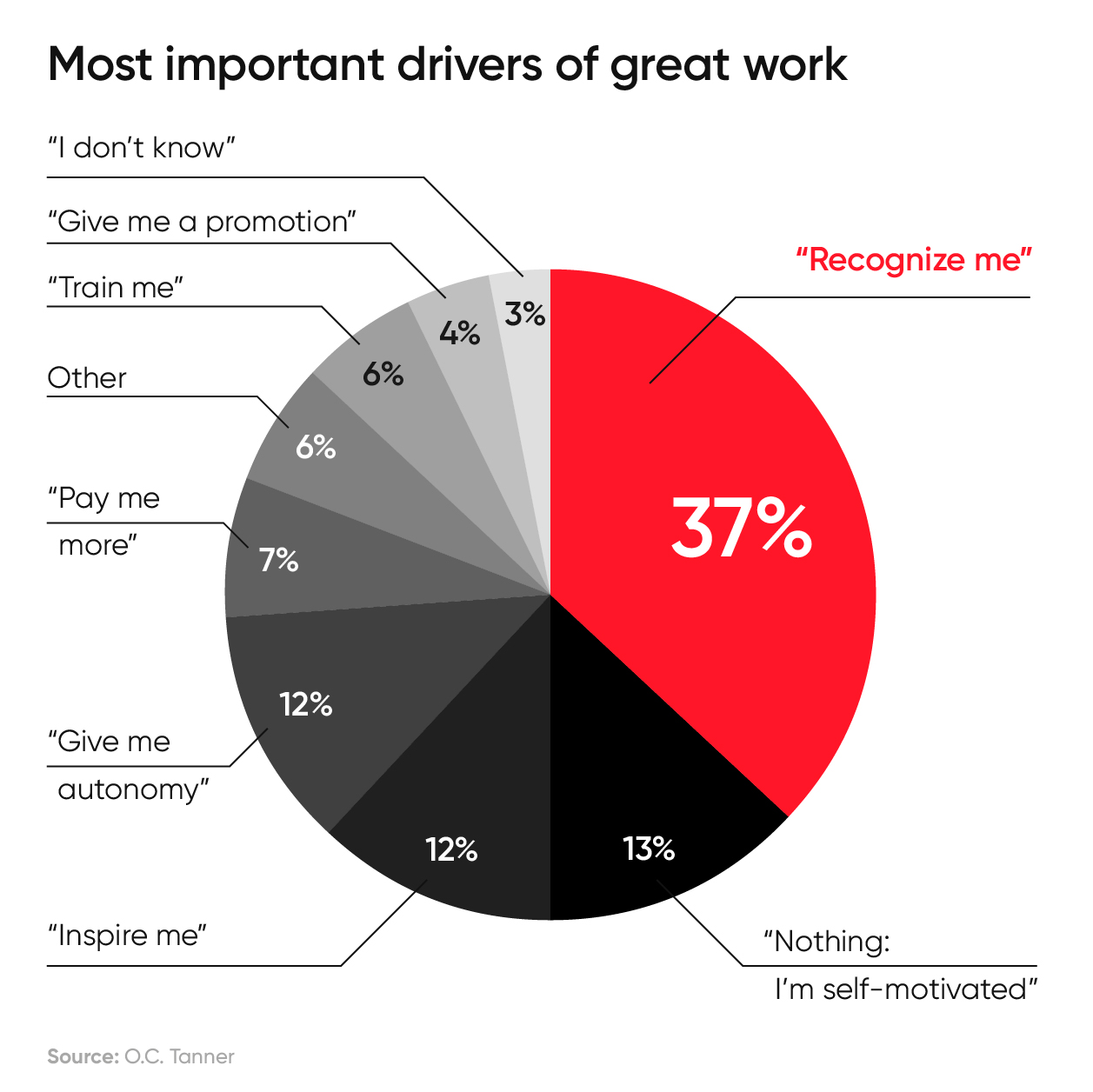
An employee survey included the question, "What is the most important thing that your manager or company currently does that would cause you to produce great work?"
Respondents answered in their own words, providing a variety of responses, but a clear pattern emerged. 37% of respondents said that more personal recognition would encourage them to produce better work more often.
While other themes like autonomy and inspiration surfaced, recognition was the most common theme that emerged from responses. The study showed that affirmation, feedback and reward are most effective for motivating employees to do their best work.
See the complete results in the chart below:
By narrowing in on several statements in Great Place To Work® Trust Index™ survey that measure how much employees feel recognized at work, we were able to see the impact of recognition culture on employee experience.
Great Place To Work analyzed 1.7 million employee survey responses gathered between 2018 and 2020 across small, mid-sized and large companies.
Recognition makes employees feel promotions are fair, spurs innovation and extra effort
After comparing the overall experience of employees who received recognition to those who don’t, we found that recognition was strongly tied to several areas of positive company culture.
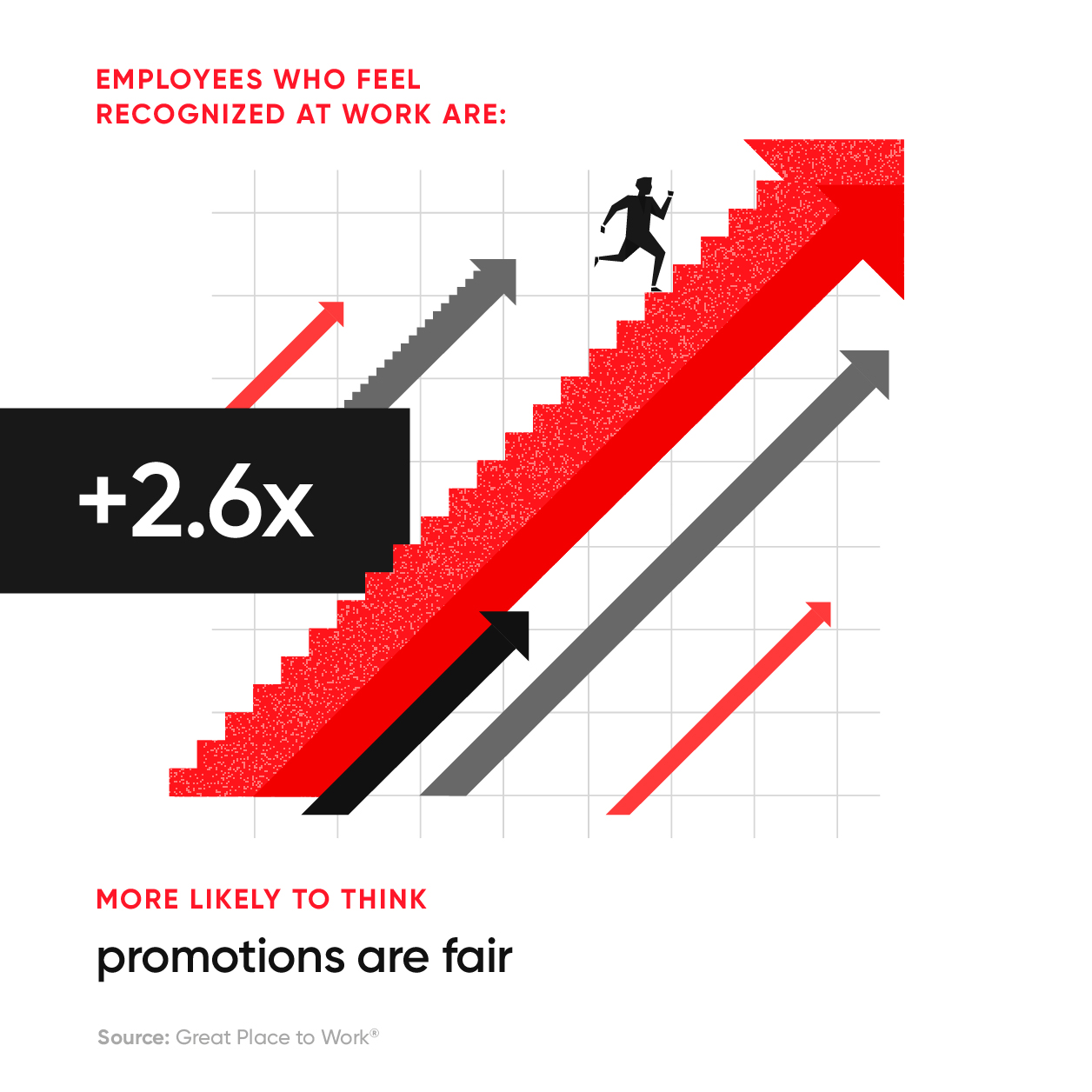
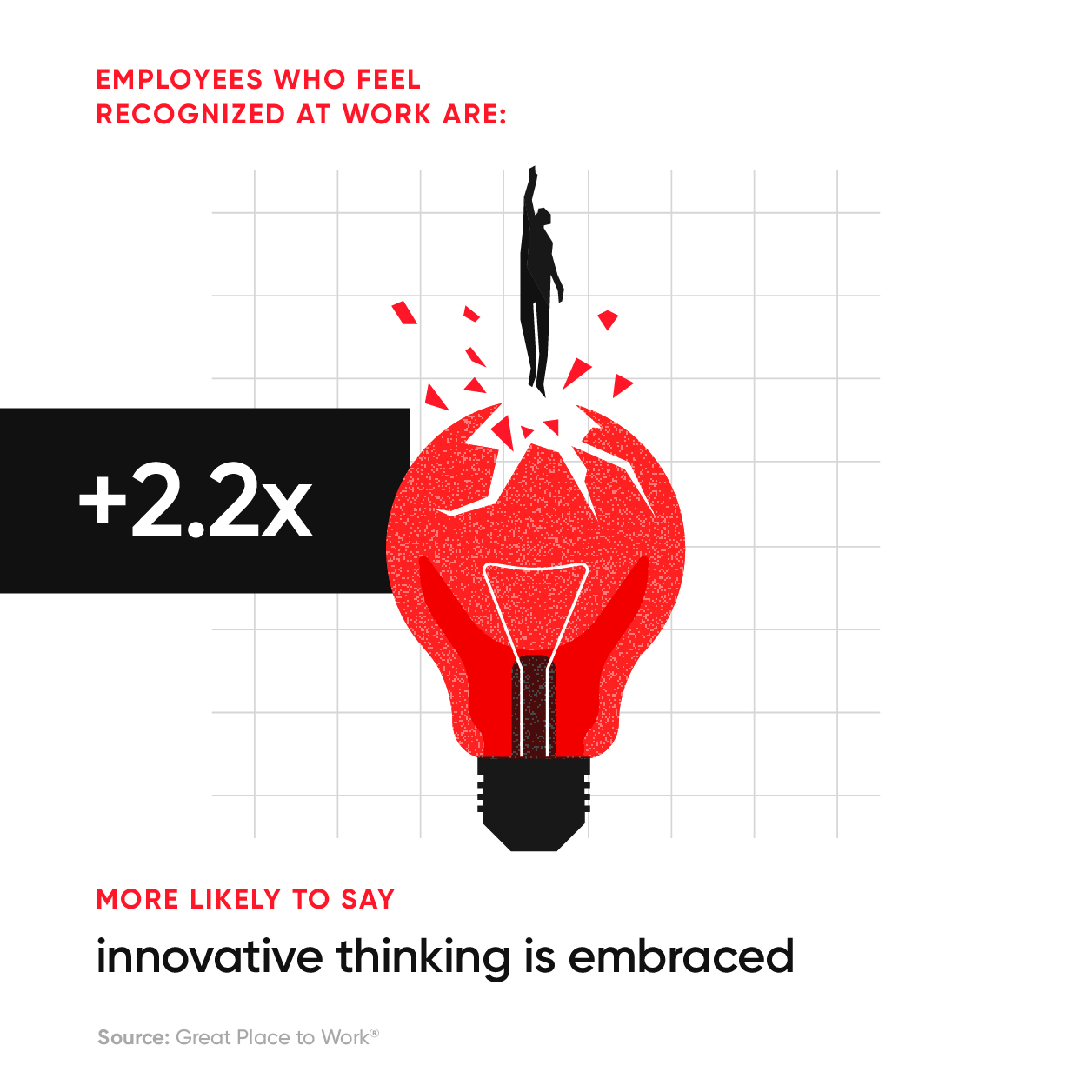
Compared to those who do not consistently feel recognized at work, people who do feel recognized at work are:
- 2.6x more likely to think that promotions are fair
- 2.2x more likely to drive innovation and bring new ideas forward
- 2.0x more likely to say people here are willing to go above and beyond
Employee appreciation is linked to higher job satisfaction
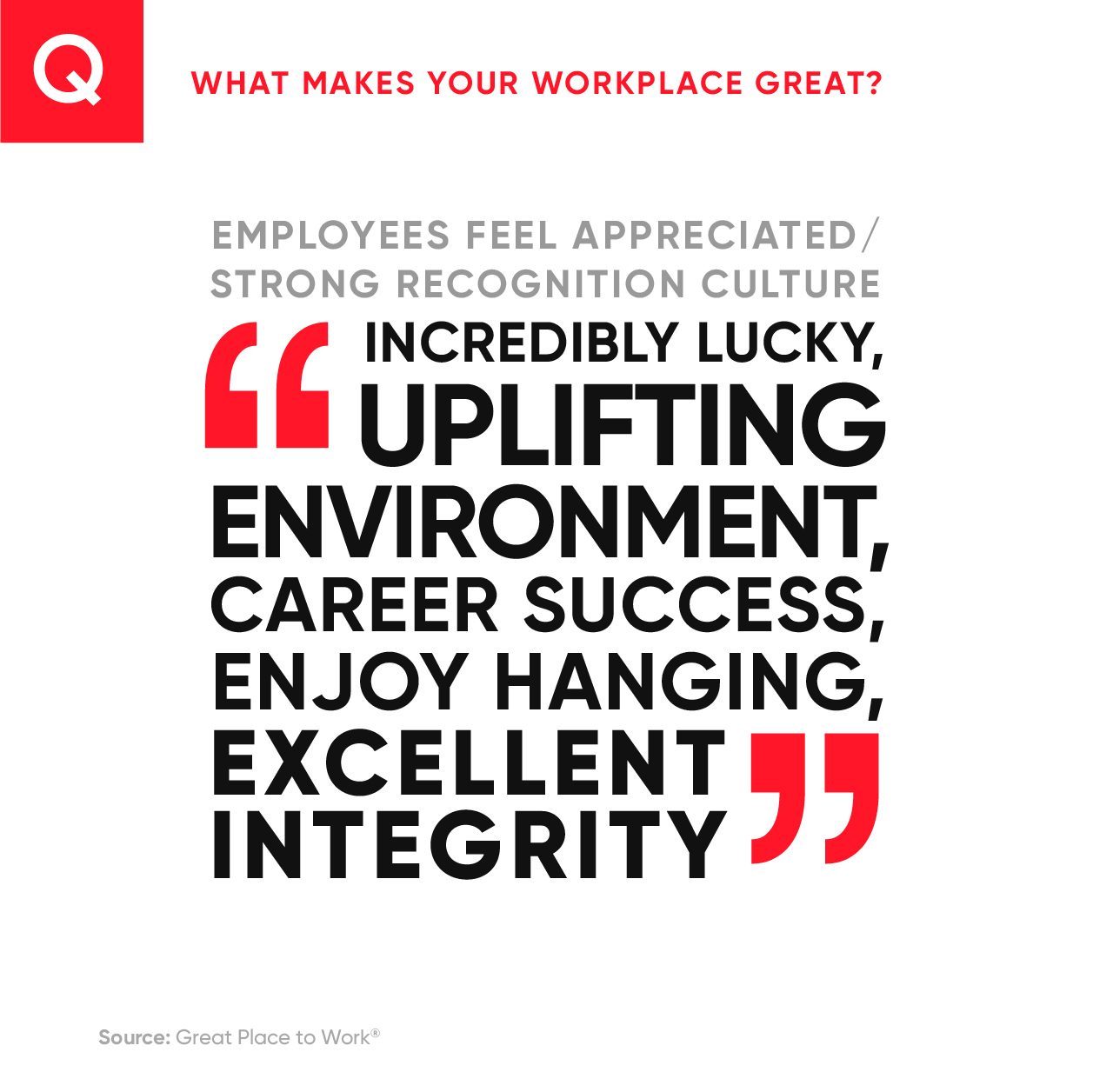
In the same Trust Index™ survey, when asked what makes their workplace “great,” employees who responded positively to survey questions measuring recognition say that they are “incredibly lucky,” “enjoy hanging” and that the company has “excellent integrity,” “uplifting environment” and some mentioned their “career success.”
Employees who don’t feel recognized also struggle to describe what makes their workplace great
Conversely, employees who don’t feel recognized at work responded to the same question with phrases such as “plays favoritism” and “popularity contest,” indicating there isn’t much that makes their workplace great. The only positive theme was “match benefits.”
When asked what would make their company better, the employees who felt unrecognized responded with phrases that indicated feelings of unfair treatment and a manipulative work environment. Words such as “rampant favoritism,” “scare tactics,” “stop eliminating” and “job tomorrow” were most common among the “unrecognized” group.
How to create a meaningful employee recognition culture
Many Great Place To Work® clients, even those with strong company cultures, face challenges when it comes to team and individual employee recognition.
While there is no universal program for every organization, all managers can use five key elements of meaningful employee recognition.
Creating a culture of recognition: 5 keys to meaningful employee recognition programs
1. Be specific, be relevant
Recognition is more meaningful when tied to a specific accomplishment or business objective. When recognizing employees, explaining what the recognition is for help employees relate the recognition to their behavior. This encourages continued strong performance.
Authentic appreciation is also tailored to the individual. Which of the five languages of appreciation in the workplace you choose to express should depend on what people prefer.
2. Be timely
Recognition that arrives months after the fact isn’t nearly as meaningful as recognition received promptly.
The longer it takes for managers to recognize employees, the less likely employees will see the affirmations as authentic. Make employee recognition a priority and have formal recognition systems in place so you can strike while the iron is hot.
3. Recognition comes in many shapes and sizes
There is a great deal of research that indicates people are motivated by more than just cold hard cash. It is also important to note that everyone has their own preference or style when it comes to giving and receiving appreciation.
Get a clearer picture of the primary language of appreciation (in a work setting) of every individual. Then, recognize them accordingly.
Beyond a bonus or a raise, consider customized gifts, taking them out for dinner or other acts that show employees their reward is personalized to them.
4. Little things go a long way
While it's crucial to recognize major accomplishments, don’t overlook the power of the everyday thank-you to motivate employees.
Writing handwritten notes, or using the intranet to promote the good behaviors of individuals, can help instill a regular culture of employee recognition. These thank-yous and shout-outs don’t have to come from managers alone; some employees may find recognition more motivating when it comes from their peers rather than from leadership.
5. Connect to the bigger picture
Recognition helps employees see that their company values them and their contributions to the success of their team and the company overall.
This is particularly key when organizations grow or change. It helps employees build a sense of security in their value to the company, motivating them to continue great work.
Regularly share news about how the company is striving to reach the mission, and explain how individual employee goals relate to that vision.
Organizations on the Fortune 100 Best Companies to Work For® list excel in employee recognition.
Here are some examples of how these winning organizations recognize and reward their employees in meaningful ways:
Examples of employee recognition
1. Make it easy for managers to celebrate employees
Global hotel chain Hilton provides managers an annual Recognition Calendar that features 365 no- and low-cost, easy-to-implement ideas for thanking employees.
The calendar includes reminders and tips for enterprise-wide, brand and department recognition programs; appreciation best practices; important dates like International Housekeeping Week; and recognition quotes to share with employees.
It also allows users to add employee service anniversaries and local events. Users can download a print-friendly PDF or import an Outlook-friendly file into their personal calendars.
2. Make recognition a red-alert event
When clients of professional services firm Crowe respond to a satisfaction survey with the names of individuals who have gone above and beyond during projects, the survey generates a "Recognize Alert."
Crowe takes Recognize Alerts one step further with its Pay It Forward program. Individuals who were recognized can "pay it forward" to other colleagues who played important roles in serving clients but weren't mentioned in the survey response.
Crowe shares the names of both Recognize Alert and Pay It Forward recipients in Crowe Newswire On Demand so others can learn from their examples and the individuals feel appreciated.
3. Meaningful gestures of gratitude
Health care system Texas Health Resources recognizes employees' milestone years of service at five-year increments.
At every milestone, honorees receive a beautiful customized celebratory yearbook. Each yearbook opens with a personalized congratulatory message of appreciation from the CEO. Inside, the honoree finds messages of thanks and appreciation from their manager and coworkers, as well as photos of the employee at work with their team, having fun and contributing to the mission.
Recognition is absolutely essential in a great workplace, and it doesn't need to be complicated or expensive.
Ask your employees what type of recognition is most meaningful to them. You may be surprised to find how much simple, genuine expressions of thankfulness inspire them to do their best.
Do you know if your employees feel appreciated?
We designed an employee survey – based on 30+ years of studying employee experience – to measure and track levels of employee recognition, trust, innovation, and more. Contact us about it today.
Credit: Claire Hastwell GPTW US

Employee engagement is a discussion that has captured the business world, as organisations and institutions globally work towards employee wellbeing, quality, innovation, sustainability to create meaning work for the employees with an aim of positively impacting the purpose of the organisation, clients, partners, and stakeholders.
Employee engagement is a key driver of productivity and efficiency in an organisation. It is all encompassing and can be used to sustain motivation in Employee Performance.
What is Employee Engagement?
It can be confused with employee experience; however, they are different. Employee experience is an employee-centric way of thinking about the organisation and takes into consideration, how employees see, hear, believe, and feel about all parts of their work life, while Employee engagement, on the other hand, is the emotional commitment an employee has to their work, the organisation and its goals.
Invariably, employee engagement is the degree to which employees invest their cognitive, emotional, and behavioral energies toward positive organisational outcomes. So, what do engaged employees look like? Generally, they are absorbed in and enthusiastic about their work and the organisation they work for.
When employers are resolute to ensure the contributions, views and voices of their employees are not only heard but also find ways to keep open communication through creating a sense of belonging and purpose for a great brand identity everywhere they operate from, there will be confidence in the abilities of individuals and teams to go above and beyond in sustaining the energy required for a formidable and consequently winning team.
High Performance organisations aim at implementing a robust employee engagement plan, to ensure the engagement of its workforce from recruitment till exit. The workplan must be achieved through well-structured employee engagement strategic programs, initiatives, and intents.
An employee engagement plan is a mechanism that organizations develop to define and prioritize their actions for improving employee engagement. It enables recognizing the key factors that influence employee engagement, identifying the employees' pain points, and creating customized initiatives to address them.
A great employee engagement strategy must be deliberated, calculated, and carefully planned. To have a successful employee engagement strategy, the use of polls, surveys and data is important, this is to allow benchmarking the performance of the strategy and sometimes flexibility to realign when it is required.
An "engaged employee" is defined as one who is fully absorbed by and enthusiastic about their work and so takes positive action to further the organisation's reputation and interests.
There are four core elements of employee engagement that one must pay attention to, they are.
- Strategic Narrative – There must be visible, empowering leadership, providing a strong strategic narrative about the organisation, where it comes from and where it’s going. Organisations must be deliberate about the way the organisation is perceived in the industry and operating environment.
- Engaging Managers- These people must focus on developing the people they manage and give them scope, treat the people as individuals, coach and stretch their people. There is a popular saying that employees do not leave bad organisations but bad managers. Team leaders and supervisors must be trained in how to manage their direct report, the aim is to ensure people are equipped and motivated to be productive on the job, without being coerced to do what they are employed for.
- Employee Voice - Throughout the organisation, there must be tools and channels for reinforcing and challenging views, between functions and externally. Employees are seen not as the problem, rather as central to the solution, to be involved, listened to, and invited to contribute their experience, expertise, and ideas. Employees who are bold to air their views, especially in the work that they do, will find ways of improving on the job. People must know and feel like they have a voice and can speak up.
- Organisational Integrity –An organization with a high level of integrity do what they say they will do, as seen by employees, customers, shareholders, and wider society. These organisations ensure that the agreed principles and values that they uphold are demonstrated in the actions and activities of the day-to-day business operations. There is no disconnect, rather, a synchronization between what is documented and the practice.
There are intrinsic and extrinsic factors of employee engagement, which are required for the success of both the organization and its employees. Intrinsic factors include Passion, Determination and Purpose, while the extrinsic factors are Workplace Environment, Family Influences and Financial Capabilities.
By introducing strategies to achieve improved engagement and retention, companies set for themselves a strong foundation for success. Utilizing talent management while building a committed and engaged workforce.
Talent management initiatives are one of the key drivers of employee engagement, staff productivity and retention, to ensure that of your company. Without a robust talent management system, you put yourself at risk of creating a disengaged and uncommitted workforce that are less likely to perform to a high standard, and more likely to leave the company.
The organization can retain talented employees by:
Creating strong career paths and highlighting advancement opportunities on the job that can engage the employees and help them advance their career or skills.
Developing competitive compensation structures and unique lifestyle benefits that reinforce how the company values its workforce.
Recognizing and celebrating employees for their accomplishments.
Investing in long-term relationships through defined assignment with success criteria and mutually beneficial outcomes.
Encouraging bonding and a pleasant workplace.
Employee satisfaction and engagement boosts employee productivity, organisations must ensure that they are continually strategic in creating engagement for its workforce.
Strategic organisations must be committed to implementing programs, initiatives and policies that will harness the strength of its people in better and diverse ways and must be dogged pursue employee engagement against all odds, only then can such organisations drive learning, growth, and development of its people not just as a necessity but as part of their overarching strategy.
Great institutions who want to thrive, especially post pandemic and in the evolving workplace must earmark audacious ambitions, which must be optimistically pursued in building formidable teams that will enhance productivity.

Employee Experience may be viewed by some as another HR buzzword; however, it is a step towards Employee Engagement. The employee experience and employee engagement are two connected elements of a business’s ability to keep its employees happy.
Employee Experience is a worker's perceptions about his or her journey through all the touchpoints at a particular company, starting with job candidacy through to the exit from the company. The company's physical workspace, culture and technology are all important components of the employee experience, which is often abbreviated as EX.
Employee experience refers to the overall experience an employee has in the workplace, encompassing everything from company culture to work-life balance to opportunities for growth and development. By prioritizing employee experience, companies can create a workplace culture that attracts top talent, fosters employee loyalty, and ultimately leads to improved business outcomes.
The business world of today is fast paced and dynamic in nature, companies are continuously looking for ways to gain a competitive edge in their industry and with their customers evolving needs. An aspect that may be overlooked by companies which can give them an edge and extraordinary benefit is employee experience. It is, therefore, important to pay careful attention to this critical area with clear understanding of its utilisation.
The War of Talents is real, the ccompetition for talent is fierce especially in the post-pandemic world. This may be on for a long time, as many professionals are constantly searching for roles that will offer better work-life balance, career growth and fulfillment and roles that align with their values. People in the marketplace will compare, shop, research and analyse the impact of roles and job opportunities before choosing their next roles. Business leaders are realizing that success in the new normal means building the best teams most effectively.
Employee experience can give companies a competitive advantage by fostering a culture of creativity and innovation. When employees feel that their ideas are valued and that they have the support required to experiment and take risks, they are more likely to come up with new and innovative solutions to business challenges. This can lead to improved processes, better products, and increased revenue and market share.
Employee experience is a long term methodology, where companies make deliberate creation towards going beyond what engagement scores are telling them to do in the moment, and focus on redesigning employee experience, creating a workplace where people want, not just need, to work each day.” That desire to work at a company as against coming to work because of the need to make a living drives employees to be better at their jobs, dedicated, committed, self-driven and loyal to the business. This guarantees productivity and success.
A focus on employee experience will assist companies build a strong employer brand. A great employer brand is one offering a clear message about the organisation, what they stand for and communicating consistently with stakeholders, raising awareness of what the organisation offers. An organisation can build a strong and sustainable employer brand with consistent and unique policies, programs and value propositions in attracting and retaining talents when interacting with them, creating development and/or performance plans for leaders,
In today's interconnected world, a company's reputation is more important than ever. By creating a workplace culture that prioritizes employee experience, companies can build a reputation as a desirable employer, which can help attract top talent and win business from customers who value socially responsible companies.
Employee experience is a key success factor for companies to retain a competitive advantage in business and thrive in a challenging operating business environment. This can be achieved through employee well-being, fostering a culture of innovation, and building a strong employer brand, companies can attract top talent, reduce turnover costs, and improve business outcomes.
In a world where every edge counts, a focus on employee experience is a smart investment for any company looking to succeed in today's marketplace. Ultimately, the end goal is the enhancement of employee experience, keep employees engaged, boost their morale and make them feel purposeful in their work