Learn about the latest organizational culture trends, best practices, and research from the global authority on workplace culture.

What truly makes a workplace great?
🔹 Trust: The Bedrock of Greatness
🔹 Leadership That Listens and Empowers
🔹 Inclusion and Belonging
🔹 Purpose and Passion
🔹 Recognition and Celebration
🔹 A Look Ahead
Great workplaces don’t happen by chance.
They are intentionally built, nurtured with care, and sustained through consistent commitment.
Are you ready to start your own journey?
With five months to go, there is still time to take meaningful steps toward transforming your culture and earning recognition as a Great Place to Work–Certified™ organisation.
Don’t wait.
Let this be the year your organisation is not just part of the audience—but part of the celebration.
➡️ Begin your culture journey today.
Connect with us to learn how your organisation can be Certified and join the ranks of Nigeria’s most admired workplaces.
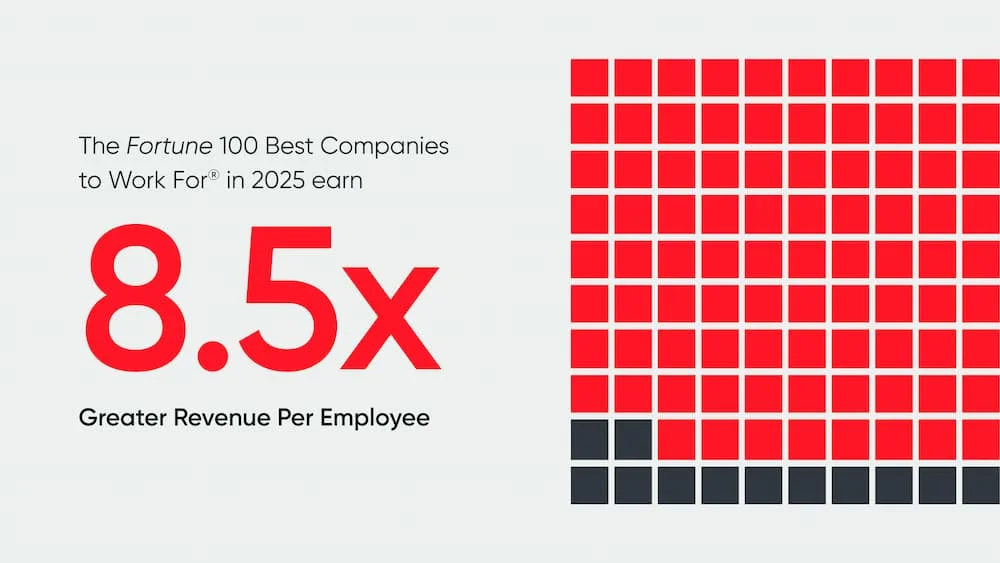
High-trust workplaces achieve more than eight times more revenue per employee and outperform the market by nearly four times.
When I talk about how employee trust boosts business performance, audiences often nod in agreement. Companies do better when their people trust them. That makes sense to most people.
But then comes the question: “Can trust be measured in dollars and cents?”
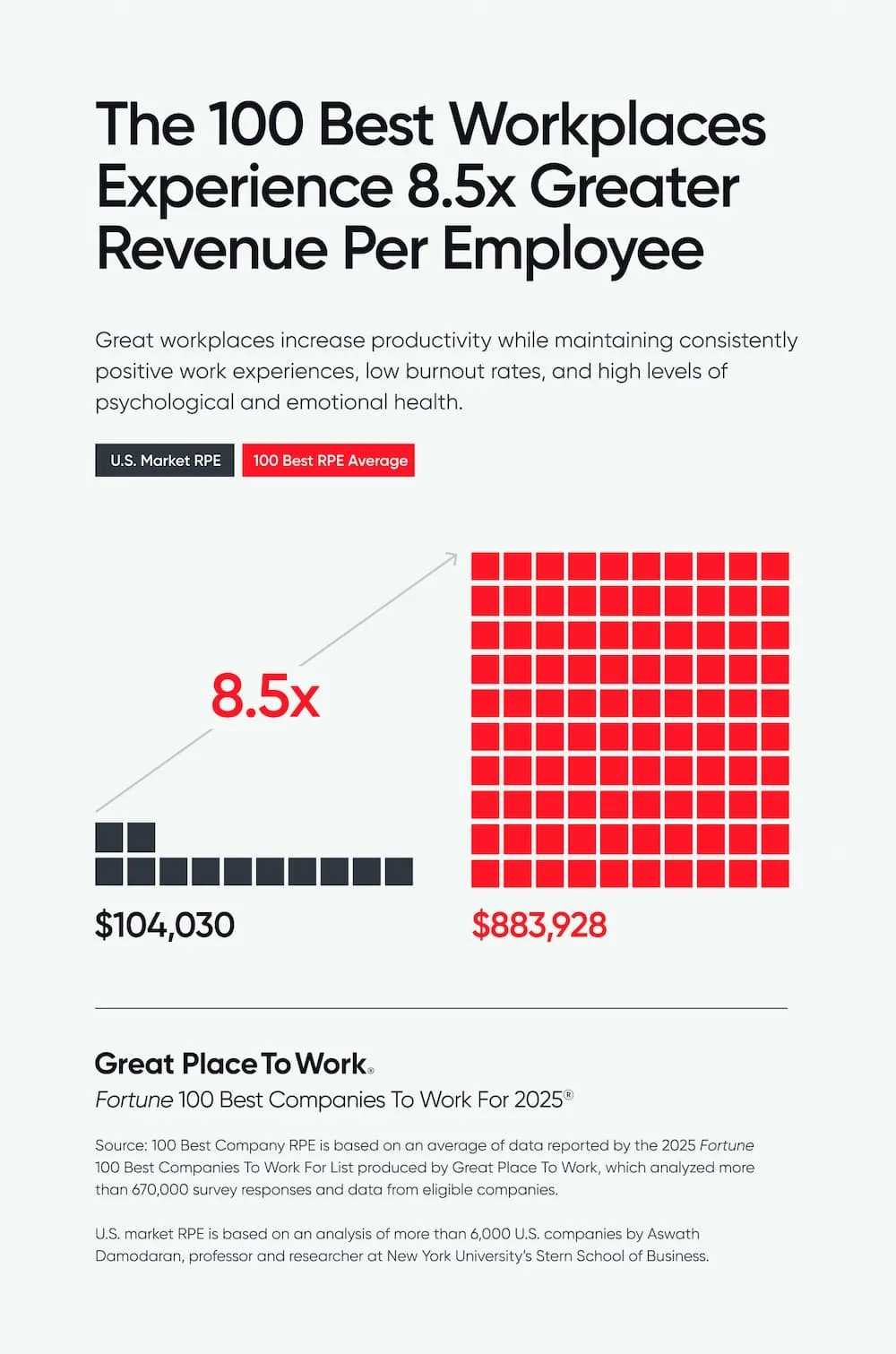
Let’s look at the 2025 Fortune 100 Best Companies to Work For®, using a common business metric: revenue per employee (RPE), which reflects the productivity and efficiency of a company’s workforce.
On average, the 100 Best Companies earn 8.5 times more revenue per employee than the U.S public market RPE. This astounding outperformance includes both public and private companies, with public companies reporting RPE that’s more than 9.4 times higher than market RPE, while private companies see more than 7.7 times higher. This financial advantage trends across industries, reinforcing the financial benefits of high-trust workplaces.
RPE success must be measured in tandem with the employee experience. The 100 Best Companies don’t hit high RPE numbers by slashing headcount and overworking their teams. Well-being isn’t sacrificed for productivity. Quite the opposite. They outperform their peers in every employee experience metric from retention and well-being to innovation and productivity, with 90% of people describing their workplace as caring.
The 100 Best Companies also more than triple their stock market performance.
More nodding from the audience. That’s what they want: Financial returns that light up Excel reports. High stock prices and skyrocketing profitability. A workplace brimming with innovation and agility, and record levels of productivity and efficiency.
Their next question: “How?”
I love this question, but not everyone loves my answer: It’s all about leadership behaviors, not just benefits. Trust isn’t built through more PTO. It’s in how leaders make people feel and the actions they take.
The 100 Best Companies have built a foundation of employee trust that fuels performance in all areas of their business — not just some areas, and not just for some people. They are more profitable and productive because they’ve created consistently positive work experiences, lower burnout rates, and higher levels of psychological and emotional health compared to typical workplaces.
Employees at these companies give extra in droves and are extremely agile, fueling high RPE levels. That doesn’t happen by giving them perks like free food or Apple watches. If it were that simple, every workplace would be great. It happens by listening to people and involving them in decisions that affect them. These leaders ensure all employees have opportunities for special recognition and make sure they believe that what they do matters; that they matter as human beings first and workers second. They’ve built organizations where transparency, well-being, and high levels of cooperation are cornerstones.
That is how business is done: with people, not to people. When that happens, the business benefits all stakeholders — from frontline workers to executives, shareholders to local communities.
The 100 Best exemplify how high-trust cultures drive business success: Leaders shape the employee experience, which in turn shapes the culture, and that culture drives business performance.
Great leaders understand that it is because of their people that they outperform. It’s why they work on the nine high-trust leadership behaviors, so their people want to show up for them, work hard, and innovate when given a chance. They listen, evolve, and meet the moment.
In an age of distrust, AI fears, geopolitical uncertainty, and record-low employee engagement levels, that moment is now.
Agility and extra effort drive productivity
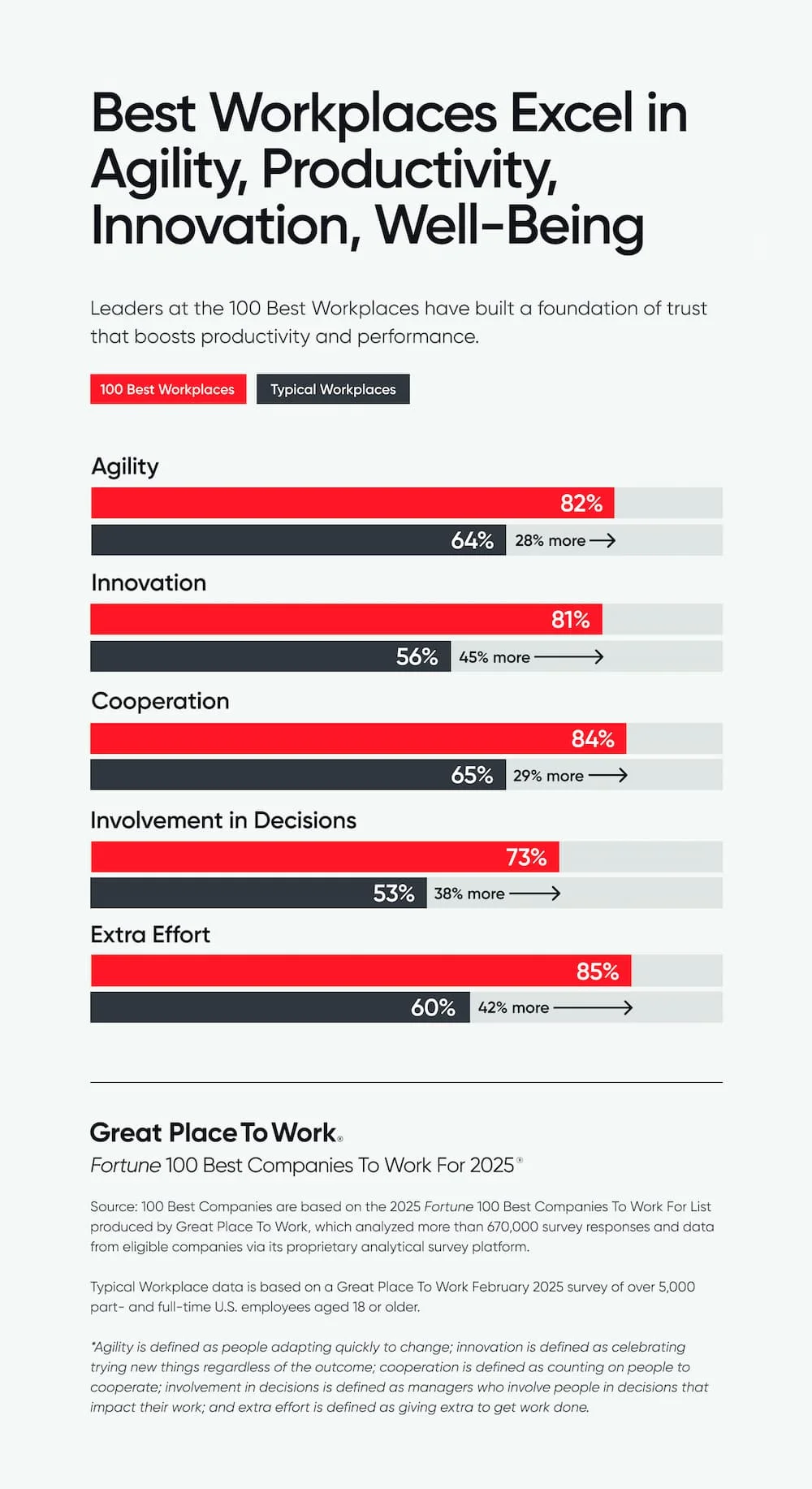
The 100 Best are more productive than their competitors, thanks to high levels of agility and discretionary effort, which boost their impressive RPE numbers.
Employees don’t give extra because they’re told to work harder or adapt faster. They go the extra mile because they work in cultures of collaboration, special recognition, and purposeful work.
At the Best Workplaces, 84% of employees say they can count on people to cooperate. Why does that matter so much? Because the likelihood of extra effort skyrockets by a jaw-dropping 720% when employees work in a cooperative workplace. And when employees feel everyone has opportunities for special recognition and their work is meaningful, they are 60% and 50% more likely to give extra, respectively, according to an analysis of 1.3 million employee surveys from Great Place To Work.
Leaders make sure people feel a sense of purpose in their work, which can boost stock performance. They build cultures of camaraderie and cooperation through training and modeling leadership behaviors.
Accenture, for example, intentionally builds and tracks cooperation through its “Leader Network Diagnostic tool” and accompanying workshop, which helps break down silos and expand and strengthen connections among colleagues.
Synchrony’s President and CEO Brian Doubles redefined leadership by incorporating high-trust leadership behaviors into the company’s values and strengthening its culture of cooperation. Over the past three years, these efforts have led to Synchrony’s stock price doubling and voluntary turnover hitting an all-time low. Its ranking on the 100 Best has jumped from No. 44 in 2020 to No. 2 in 2025.
Not only do employees at winning companies give more effort, they’re able to quickly adapt to changes because they’re well-informed, understand their impact on the business, and feel empowered to voice their opinions.
But it’s when organizations celebrate new and better ways of doing things, regardless of the outcome, that agility soars — by 250%, according to 1.3 million survey responses.
For that to happen, you must have psychologically safe workplaces for people to speak up, as Harvard professor and bestselling author Amy Edmondson shared. Eighty-one percent of people at the 100 Best describe their company as psychologically and emotionally healthy compared with 57% at typical companies. When employees can try new things without fear, innovation thrives, as does financial success. Companies that excel in “Innovation By All” experience 550% faster revenue growth.
Listening to and empowering employees to innovate has led to business success at Credit Acceptance, where leaders hold themselves accountable for acting on employee feedback. The company publishes a report on how many questions have been asked year-to-date, the number of up and down votes, and the status of those on which they have committed to “take action.”
Agility is also 50% more likely when employees believe their leaders have a clear strategic vision, and 40% more likely when they are actively involved in decisions that affect them. It’s why leaders at Hilcorp Energy give employees access to the same financial information they have. They hold monthly meetings to keep everyone informed and involved in discussions about the company’s financials, breaking down details so employees learn how their contributions are linked to the company’s success.
Every leader today can create a culture that fuels business performance, no matter the company size, industry, or budget. The building blocks of employee trust are the same.
Focus on leadership — at all levels and for everyone. When you do, your business will be more profitable, productive, efficient, innovative, and resilient.
Article written by: Michael Bush, CEO of Great Place To Work®.

Creating a positive and productive work environment is essential for any organisation's success. Here are ten workplace best practices that can foster employee well-being, promote diversity, and enhance company culture. Implementing these strategies can lead to a more engaged, motivated, and high-performing workforce.
1. Prioritize Employee Well-Being
Ensuring the well-being of employees is key to their productivity and job satisfaction. Provide resources for mental health, promote a healthy work-life balance, and create a supportive environment where employees feel valued and cared for.
2. Foster Open Communication
Open communication builds trust and ensures everyone is on the same page. Encourage regular feedback, hold open forums for discussion, and ensure transparency in decision-making processes to keep employees informed and engaged.
3. Promote Diversity and Inclusion
A diverse and inclusive workplace brings together different perspectives and ideas, driving innovation. Implement policies that promote equal opportunities, celebrate cultural differences, and ensure everyone feels included and valued.
4. Offer Professional Development
Investing in employees' professional growth benefits both the individual and the organisation. Provide access to training programs, workshops, and career advancement opportunities to help employees develop their skills and progress in their careers.
5. Recognize and Reward Performance
Recognizing and rewarding employees for their hard work and achievements boosts morale and motivation. Develop a recognition program that highlights employee contributions and offers meaningful rewards.
6. Create a Collaborative Environment
Collaboration fosters creativity and improves problem-solving. Design workspaces that encourage teamwork, use collaborative tools and platforms, and promote a culture where sharing ideas and working together is the norm.
7. Implement Flexible Work Arrangements
Flexible work arrangements can enhance work-life balance and increase job satisfaction. Offer options such as remote work, flexible hours, and compressed workweeks to accommodate different employee needs and preferences.
8. Ensure Fair Compensation and Benefits
Competitive compensation and comprehensive benefits packages are essential for attracting and retaining top talent. Regularly review and adjust salaries, provide health insurance, retirement plans, and other benefits that support employee well-being.
9. Cultivate a Positive Company Culture
A positive company culture promotes a sense of belonging and purpose. Define and communicate your organisation’s values, celebrate successes, and ensure that leaders model the desired behaviors to reinforce a positive culture.
10. Encourage Work-Life Balance
Work-life balance is critical for maintaining employee well-being and productivity. Encourage employees to take breaks, use their vacation time, and avoid overworking. Support initiatives that help employees manage their time effectively.
Implementing these ten essential workplace best practices can significantly improve employee well-being, promote diversity, and enhance your company culture. By prioritizing these strategies, you create a work environment where employees feel valued, motivated, and empowered to contribute their best efforts. In turn, this leads to a more productive, innovative, and successful organisation. Start making these changes today and witness the positive impact on your workforce and overall business performance.

In an era where workplace culture is a critical differentiator, organisations are increasingly turning to certifications to strengthen their employer brand. Among the most respected certifications is the Great Place to Work® designation, which recognizes companies that foster high levels of trust, pride, and camaraderie among employees. But what makes this certification so impactful, and how do organisations leverage it to stand out in a crowded market? Let’s dive deeper, with insights from Great Place to Work® itself.
1. The Science Behind the Certification
Great Place to Work® is built on decades of research into what makes a workplace truly great. Their methodology revolves around the Trust Index© Survey, which measures employee perceptions across five key dimensions:
- Credibility: Do leaders communicate effectively and act with integrity?
- Respect: Are employees treated fairly and with dignity?
- Fairness: Is there equity in opportunities and rewards?
- Pride: Do employees feel proud of their work and their organization?
- Camaraderie: Is there a sense of community and teamwork?
According to Great Place to Work®, companies that score highly in these areas are not only better places to work but also outperform their peers in financial performance and innovation. This scientific approach gives the certification its credibility and makes it a valuable tool for employer branding.
2. Standing Out in a Competitive Market
Great Place to Work® certifications are more than just accolades—they are powerful differentiators. Inclusion in lists like the Fortune 100 Best Companies to Work For® or regional "Best Workplaces" rankings instantly elevates a company’s profile.
For example, Wema Bank, a top performer, uses its certification to highlight its commitment to equality and innovation. Similarly, Hilton leverages its Great Place to Work® designation to attract talent in the competitive hospitality industry. These certifications act as a seal of approval, signaling to job seekers that the organisation is a top-tier employer.
3. Attracting the Right Talent
Certifications help organisations attract candidates who align with their values. For instance, a company awarded as a "Best in Promoting Employee Wellbeing Practices" can appeal to candidates who prioritize programs that foster employee’s well-being, work-life integration and the creation of amiable work environment as a whole. Great Place to Work® research shows that employees in certified companies are more likely to:
- Feel a sense of belonging.
- Believe their work is meaningful.
- Recommend their employer to others.
This alignment between organisational values and employee expectations is critical for long-term retention and engagement.
4. Boosting Employee Pride and Advocacy
Certifications don’t just attract talent—they also inspire current employees. When employees see their organisation recognized as a great workplace, it fosters a sense of pride and loyalty. Great Place to Work® data reveals that employees in certified companies are:
- 93% more likely to look forward to coming to work.
- 88% more likely to recommend their employer to others.
For example, SC Johnson, a family-owned business, uses its certification to reinforce its reputation as a family-friendly employer. This pride translates into higher engagement and stronger advocacy, as employees become ambassadors for the brand.
5. Driving Business Success
Great Place to Work® research consistently shows a strong correlation between workplace culture and business performance. Certified companies often outperform their peers in areas like:
- Revenue growth.
- Customer satisfaction.
- Innovation and agility.
For instance, companies on the Fortune 100 Best Companies to Work For® list have been shown to deliver 2-3 times higher shareholder returns compared to the market average. This makes certification not just a badge of honour but a strategic business advantage.
6. Leveraging Certification in Marketing and PR
Certifications provide a wealth of content for marketing and public relations efforts. Organisations can use their certification to:
- Publish press releases announcing their achievement.
- Create social media campaigns featuring employee testimonials.
- Highlight their commitment to workplace excellence in recruitment materials.
For example, Cisco regularly shares stories about its workplace culture, using its Great Place to Work® certification as a cornerstone of its employer branding strategy.
Insights from Great Place to Work®
Great Place to Work® emphasizes that certification is not just about recognition—it’s about continuous improvement. Organisations that participate in the certification process gain access to:
- Benchmarking data: Compare their performance against industry peers.
- Actionable insights: Identify areas for improvement and implement targeted strategies.
- Best practices: Learn from top-performing companies and adopt proven strategies.
This focus on growth and development ensures that certified companies remain at the forefront of workplace excellence.
Real-World Examples
- Sun King: Uses its certification to highlight its effort to give their younger workforce a sense of purpose.
- Hilton: Showcases its certification to attract talent in the competitive hospitality industry.
- SC Johnson: Leverages its certification to reinforce its reputation as a family-friendly employer.
Conclusion
Certifications from Great Place to Work® are more than just accolades—they are powerful tools for building and enhancing an employer brand. By showcasing a commitment to trust, inclusivity, and employee well-being, organisations can attract top talent, retain their best employees, and drive business success.
As Great Place to Work® research shows, great workplaces are not just better for employees—they are better for business. In a world where workplace culture is a key differentiator, certification is a strategic advantage that no organisation can afford to ignore.
Ready to join the ranks of the world’s best workplaces? Earn your Great Place to Work® certification today and let your employees’ voices be heard. Start your journey to becoming a certified great workplace!