Learn about the latest organizational culture trends, best practices, and research from the global authority on workplace culture.
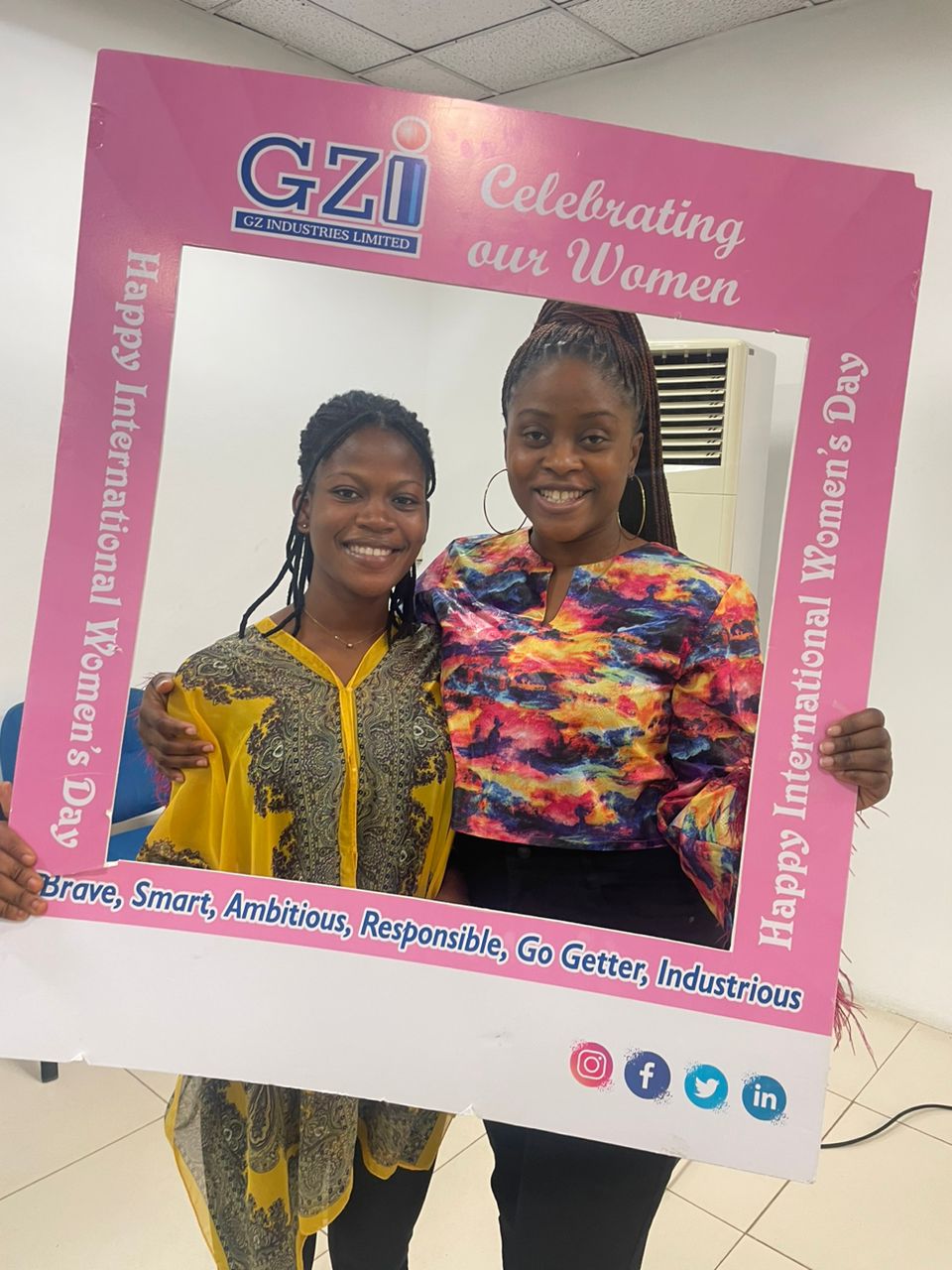
The 2024 GZI International Women's Day celebration unfolded like a tapestry of empowerment, unity, and joy. The event hosted by the charismatic Tolulope Eko, our HR specialist, brought together incredible GZI women and of course supportive men, setting the stage for an unforgettable experience.
The celebration commenced with the resonating notes of the GZI Anthem, echoing through the venue, setting the tone for an inspiring event. Ebi Okediadi, our Procurement Specialist, with grace and sincerity, led the gathering in an opening prayer, setting the spiritual foundation for the day. Joseph Damisa, one of our supportive men took the stage to deliver a powerful opening speech titled "Inspire Inclusion". His words ignited the flame of unity and empowerment, emphasizing the importance of diversity in achieving collective success. The topic encouraged everyone to recognize the unique perspectives and contributions of women from all walks of life.
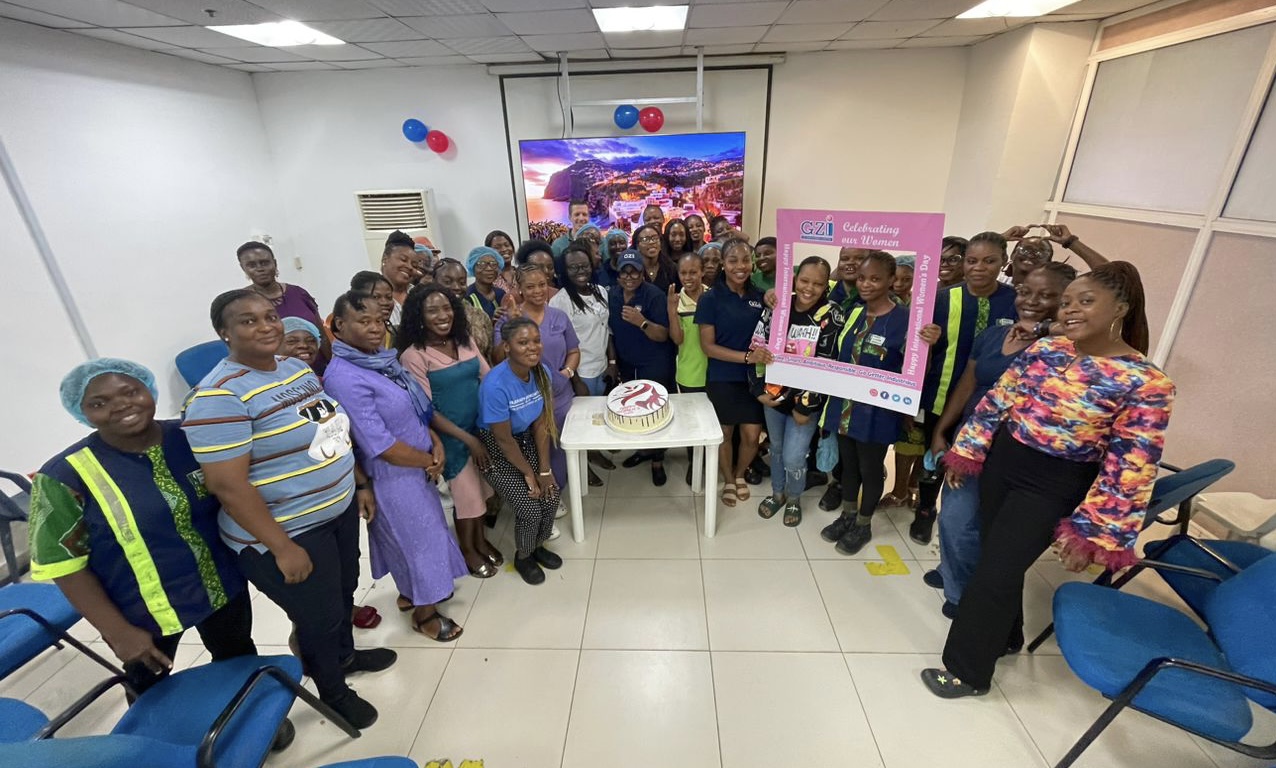
Eko Tolulope, an HR specialist with a passion for work-life balance, then took the spotlight. Her insightful session on managing multiple responsibilities and optimizing output resonated with every attendee, offering practical advice for navigating the intricate dance of professional and personal life. The celebration then shifted gears as Safoa Ampofo, the Group Head of Procurement, took the centre stage. Her presentation, "Count Her In: Accelerating Gender Equality Through Economic Empowerment," illuminated the path towards a future where women's economic prowess is recognized and celebrated.
A burst of excitement filled the air as Ifeoma and Faith emerged victorious in the engaging game activities, adding more excitement to the celebration. Olayemi Olaoye, the Group Internal Controls & Risk Assessment Manager, took the women on a journey to financial empowerment with his session, "Becoming a Financial Woman: The Money Year." The interactive session ended with a quiz, with Melody, Martha, and Dorcas emerging as the triumphant winners.
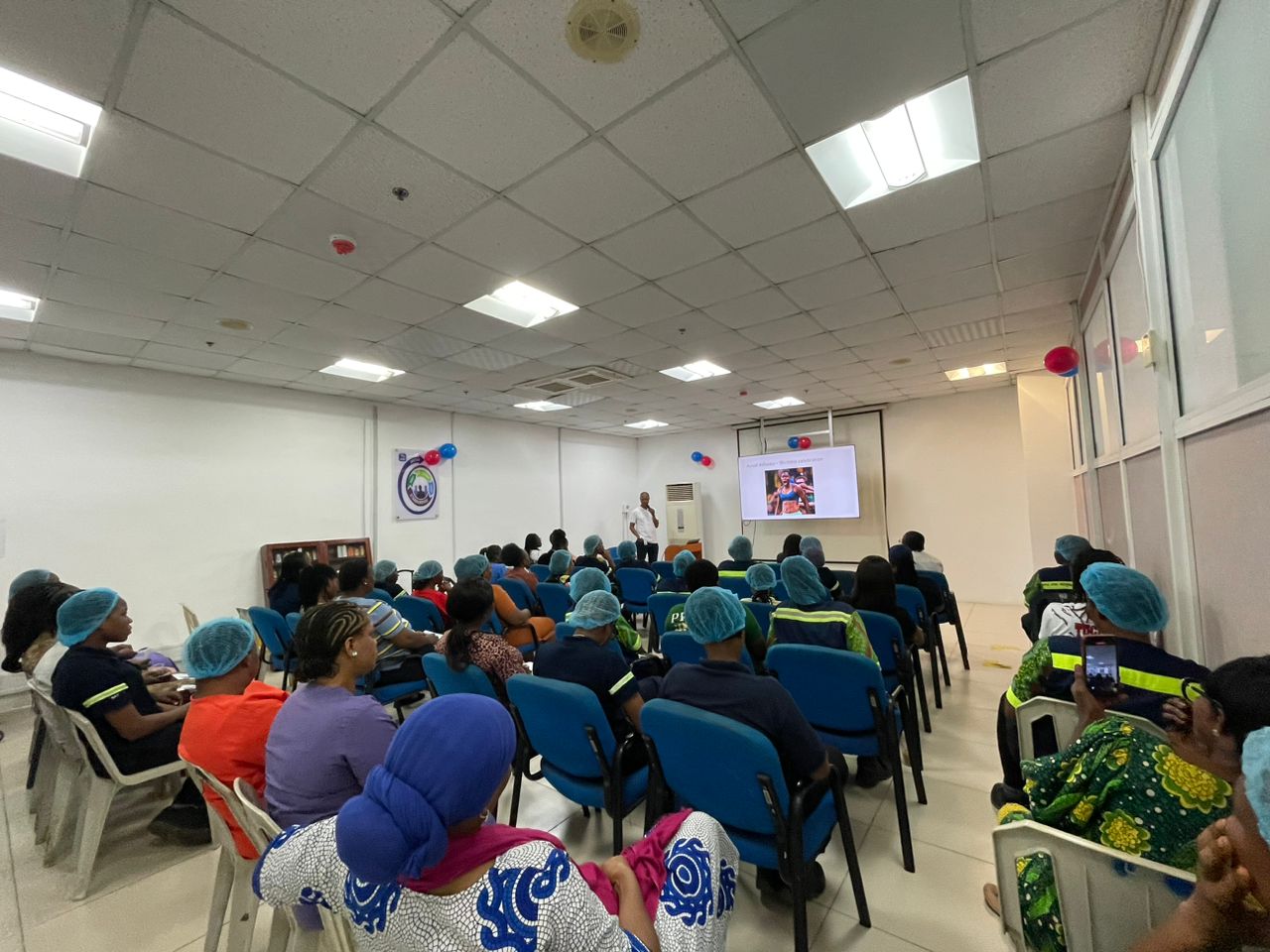
As the event unfolded, the dance floor came alive with energetic moves and vibrant smiles, a testament to the joyous atmosphere of the occasion. Uju dazzled everyone with her impressive dance skills, while Melody serenaded the audience with her beautiful voice, creating unforgettable moments of celebration and camaraderie. To cap off this extraordinary day, all participants were gifted with a special souvenir.
The program, skilfully anchored by Tolulope Eko, lasted for about two hours, leaving a lasting impression of empowerment and unity. Light refreshments and a delightful cake added the perfect finishing touch to an event that will be cherished in the hearts of all who attended. The 2024 International Women's Day celebration at GZI hosted internally was not just an event; it was a celebration of strength, unity, and the boundless potential of every woman.
Enclosed in this are the sights and sounds of the event to give you a taste of the celebration moments.
CREDIT: Adeniyi Ojo, GZI
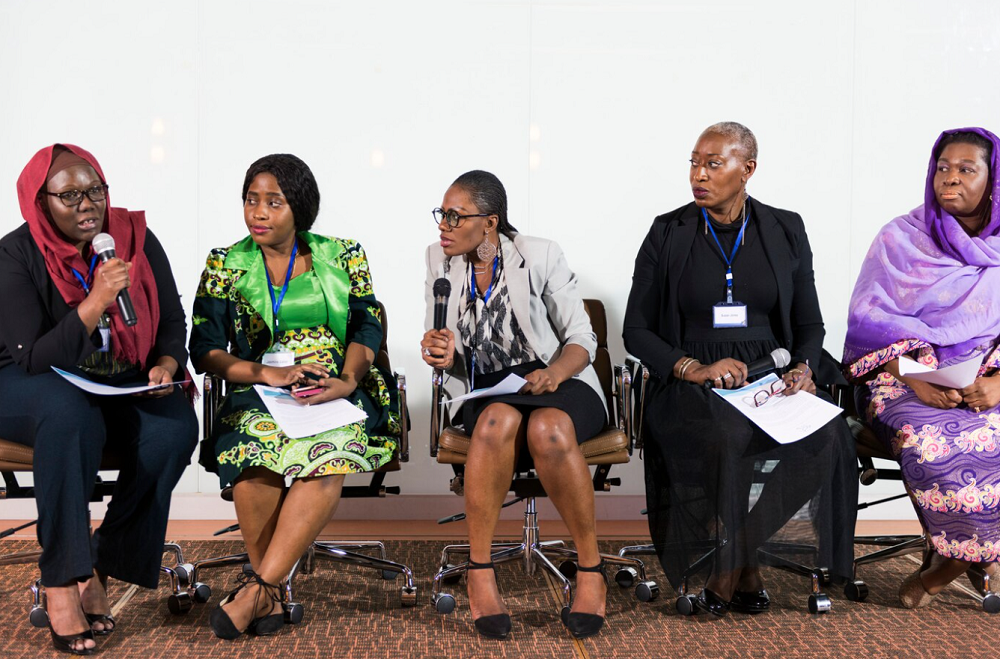
As International Women's Day approaches, it's a timely reminder for employers in Nigeria to reflect on the importance of promoting gender diversity and inclusion in the workplace. While progress has been made in recent years, women still face numerous challenges and barriers to advancement in many industries, especially the manufacturing sector, where we see a 10% between the favourable employee experience men have working in this industry compared to women. Employers have a crucial role to play in creating an environment that empowers and supports women to thrive professionally. We'll explore some initiatives that employers can implement to promote gender equality and empower women in our Nigerian workplaces.
Equal Pay and Pay Transparency:
One of the most fundamental steps employers can take is to ensure equal pay for equal work. Equal pay isn't about paying everyone the same regardless of their job responsibilities or performance. Instead, it's about ensuring that individuals receive fair compensation for the work they do, regardless of gender. Conduct regular pay equity audits to identify and address any gender pay gaps within the organization. Implement transparent salary policies that clearly outline pay scales and criteria for advancement, promoting fairness and accountability.
Development Programs:
Invest in development programs specifically tailored to women, providing them with the skills, resources, and opportunities needed to advance in their roles. Offer mentorship and sponsorship programs that pair female employees with senior leaders who can provide guidance, support, and advocacy for their career advancement.
Flexible Work Arrangements:
Recognize and accommodate the diverse needs of women in the workforce by offering flexible work arrangements, such as remote work options, flexible hours, and compressed workweeks. Providing flexibility allows women to better balance their professional and personal responsibilities, leading to increased job satisfaction and retention.
Childcare Support:
Address the challenges faced by working mothers by providing childcare support and resources. Offer onsite childcare facilities or subsidies for childcare expenses, lactation rooms, and parental leave policies that support both mothers and fathers in balancing their caregiving responsibilities with their careers. An organisation like Courteville Business Solutions Plc offers its employees' children free education up to Primary 6 in its government approved nursery and primary school.
Gender Diversity Training:
Implement gender diversity training programs for employees at all levels of the organisation to raise awareness of unconscious biases, promote inclusive behaviours, and foster a culture of respect and equality. Provide training on topics such as gender sensitivity, inclusive leadership, and creating a supportive work environment for women.
Employee Resource Groups (ERGs):
Establish employee resource groups dedicated to women to provide a supportive community where female employees can connect, share experiences, and access resources and professional development opportunities. ERGs can serve as advocates for gender diversity and inclusion initiatives within the organization, driving positive change.
By implementing these initiatives, employers here in Nigeria and beyond can create a more inclusive and supportive workplace environment where women are empowered to reach their full potential. As we celebrate International Women's Day, let's reaffirm our commitment to promoting gender equality and fostering a culture of respect, diversity, and inclusion in Nigerian workplaces. bearing in mind also that diversity and inclusion breed creativity and innovation, which are relevant for business continuity. Together, we can build a brighter future where every woman has the opportunity to thrive and succeed.
It was the threat from 700 of the company’s 770 employees to quit that brought ousted CEO Sam Altman back.
OpenAI, the creator of ChatGPT and Dall-E, has leapt to the front of the generative AI wave crashing into workplaces and companies around the world.
Companies like Microsoft have made big bets on the start-up, and ChatGPT has become the fastest growing consumer product in history with 100 million active users in just two months. So, when the non-profit’s board suddenly fired CEO Sam Altman, the news shook the industry.
Why the company would try to remove an executive that oversaw such historic growth has much to do with the company’s unusual corporate structure and stated mission to build artificial intelligence outside the usual tech ecosystem.
Attend our annual company culture conference May 7-9, 2024
The palace intrigue of who wanted to remove Altman and why offers few lessons for business leaders trying to navigate the disruption generative AI promises to unleash. Instead, the episode draws a clear picture of the role workplace trust has on the success or failure of a robot-assisted workplace.
Start with trust
As AI disrupts workplace norms, trust will come at a premium. Companies will only succeed in developing new technologies with AI if they can build trust with important stakeholders.
“We believe that companies and people are going to think about who they trust,” shares Michael C. Bush, CEO of Great Place To Work®. Speaking with other leaders at a virtual roundtable for Fortune, Bush made the case for trust as the key ingredient in bringing AI successfully into the workplace.
To figure out who to trust, many will look at how employees feel about their company, he says. “One of the considerations: finding companies where the employees trust the companies … not a bad place to start.”
A messy leadership shake-up can undermine that trust, and OpenAI’s board discovered just how those missteps can drive employees to act.
More than 700 of OpenAI’s 770 employees signed a letter demanding that Altman be reinstated as CEO, including board member Ilya Sutskever, who had been part of Altman’s ouster. The employees threatened to join Altman at Microsoft to build AI technology directly for the company that had invested billions in OpenAI.
Such a letter from employees demonstrates how the board lost the trust of the rank-and-file workers at the company. The board eventually brought Altman back, and it’s been remade with new additions like former Treasury Secretary Lawrence Summers.
Now OpenAI will have to try and rebuild trust.
“We’ll look back on this period as a very brief, highly dramatic blip that gave us a public and dramatic reset,” said Aaron Levie, chief executive of Box, to The New York Times. “This needs to be a trustworthy organization that’s aligned with its board, and at the end of it all, OpenAI is a more valuable organization than it was a week ago.”
How to build trust
Great Place To Work has identified three key ingredients in a high-trust workplace culture: credibility, respect, and fairness.
Each of these ingredients is tied to leadership behaviors which can help build trust with employees. “The trend for 2024 is leaders have to up their game,” Bush says.
When OpenAI removed Sam Altman, it violated a core tenet of a high-trust workplace culture: communication and transparency.
The board lost credibility because it didn’t communicate clearly about its decisions. An initial statement that Altman had failed to be “consistently candid in his communications with the board” didn’t satisfy employees.
At the Best Workplaces™, leaders take care to listen to the concerns of employees with surveys and listening groups. More importantly, leaders take action on the issues raised.
“If you don’t do anything, people aren’t going to take the next survey,” Bush says.

Speaking” — one of the nine high-trust leadership behaviors — is about more than what you say, or how you say it.
Communication is one of the primary functions of a leader at any level.
That doesn’t mean you have to be a great “talker” with the affability and style of a used-car salesman. Instead, you have to be a strategic, empathetic, and tireless sharer of the information employees need to hear.
To be someone that others will follow, you must communicate your vision, share updates about progress toward your goals, and make sure every employee knows how they are expected to contribute to those goals. That’s why “speaking” is one of the nine high-trust leadership behaviors Great Place To Work® has identified as the keys to building trust with employees.
Attend our annual company culture conference May 7-9, 2024
“Speaking is more than what you say and who you say it to, it is how you share information,” writes Michael C. Bush, CEO at Great Place To Work. Is your message getting to your desired audience, and is your message delivered in a way that your target audience can easily follow?
Great workplaces share timely information in a variety of channels and formats, ensuring employees understand the bigger picture behind business decisions and promote a culture of transparency.
“Consider your receptionist,” Bush says, pointing to a role that is often invisible to top leaders in the organization. “Whenever you speak with them, reiterate, emphasize, and clarify how important their job is. When someone walks in a building or contacts a receptionist on the phone, that’s a connection to the brand. In a few seconds, a caller or visitor either feels cared for, important, and listened to, or they don’t.”
What great speaking looks like
Here are four best practices that Great Place To Work Certified™ organizations follow to ensure leaders are sharing information broadly and fairly with every employee in the organization:
1. Meet employees where they are, through channels that fit their work and habits
A company should meet employees on their terms, and savvy leaders know that not every employee is going to read an email newsletter.
At DHL Express, a social intranet tool called Smart Connect offers a one-stop shop where employees can find relevant news, strategic updates from management, HR documents and information, a job portal, and more. The tool also has a social wall where everyone can share stories, photos, and videos. The app has more than 100,000 users across the DHL workforce.
World Wide Technology knew that employees on the floor of its integration centers did not have access to regular communication platforms like email or online chat. To reach these deskless employees, the company launched an SMS texting system, ensuring these employees received important business updates and safety notices.
For companies like industrial gases manufacturer Messer, reaching populations like drivers out on the road comes with unique challenges. They need to deliver important information, but do not want to distract their workers while they are driving.
For drivers, each day starts with logging into a company system to check their route for the day.
“When we want somebody to take an action, we’ll put a little pop-up message onto the system because we know our drivers will log into it every day,” says Jem Janik, people and culture communications manager at Messer Americas.
Pop-ups have also been added to HR systems so employees find them when updating their time sheets. Text messaging was added after the team heard from a leader in the engineering services group that their team was more likely to text one another than send an email.
2. Prepare managers to share important information one-on-one
“Speaking” doesn’t require radical transparency. Rather, leaders who are great at speaking think carefully about how information is released throughout the organization.
Regular one-on-one meetings with a people leader ensures that every employee has a personal connection to management and feels that a leader is considering their individual needs. At CarMax, an Associate Connection Plan Guide was developed to ensure regular meetings occurred for every employee at each of its stores.
When sharing information about pay and performance, WP Engine considered how employees would use pay information, not only about their roles, but roles that they hoped to get later in their careers.
The company shares pay range information with employees in the relevant job family, and pay range information for internal opportunities that an employee might be qualified for.
To be successful, WP Engine had to train managers to have one-on-one conversations about pay with employees.
“Some managers are uncomfortable with difficult development conversations, so they’re going to be uncomfortable with difficult pay conversations as well,” says Priya Bhavsar, senior director of total rewards for WP Engine. “But it’s exactly the same thing, because your pay is representative of your performance: how qualified you are for the job, how you’re growing in your role.”
3. Curate the amount of information you share with employees
Great leaders have to also know when they are sharing too much information. Expecting employees to sift through all your communications to find relevant messages doesn’t signal an awareness of their needs and challenges.
Sheetz, a convenience retail chain based in Pennsylvania, took steps to simplify its communication by mapping the employee journey using focus groups to identify all the communication touchpoints. The retailer then simplified, using UKG’s mobile app to streamline corporate communication with hourly employees and removing managers as gatekeepers to communication.
The company also launched an internal communications strategy to create clear guidelines for communication channels, identifying the audiences they serve and the types of information that should be shared through each channel.
4. Set an example with leaders and vulnerability
Leaders can build trust when they demonstrate vulnerability. Great “speaking” includes sharing candidly with employees about challenges facing the business.
When Camden Property Trust had to reorganize and eliminate some roles, the property developer knew it had to bring employees into the process from the beginning. In the face of change, it’s crucial to acknowledge the elephant in the room, says Allison Dunavant, VP, organizational development.
“Acknowledge the change and ask your team members how they’re doing,” Dunavant says. It’s also important to acknowledge when you don’t have all the answers.
“No one expects you to know all the answers or even understand how a change might impact somebody else,” she says.
Rinse and repeat
Great workplaces and the leaders that create them understand that effective communication requires patience and repetition. A message hasn’t been meaningfully shared until it has been digested by your target audience.
The best leaders are those that send messages through a variety of channels, with a focus on consistency and clarity. It’s often just when you’ve exhausted yourself from repeating your message that your point finally starts to sink in.
Benchmark your workplace culture
Find out how your workplace culture stacks up against the most reliable benchmarks available via Great Place To Work Certification™.
CREDIT: TED KITTERMAN

Here's how the best companies in the world create winning workplace cultures.
The basic elements of a positive employee experience don’t change depending on where in the world you live.
Employees in Nigeria need the same things from their managers and colleagues as employees in Europe or Asia: trust in leaders, pride in their work, and connection to coworkers.
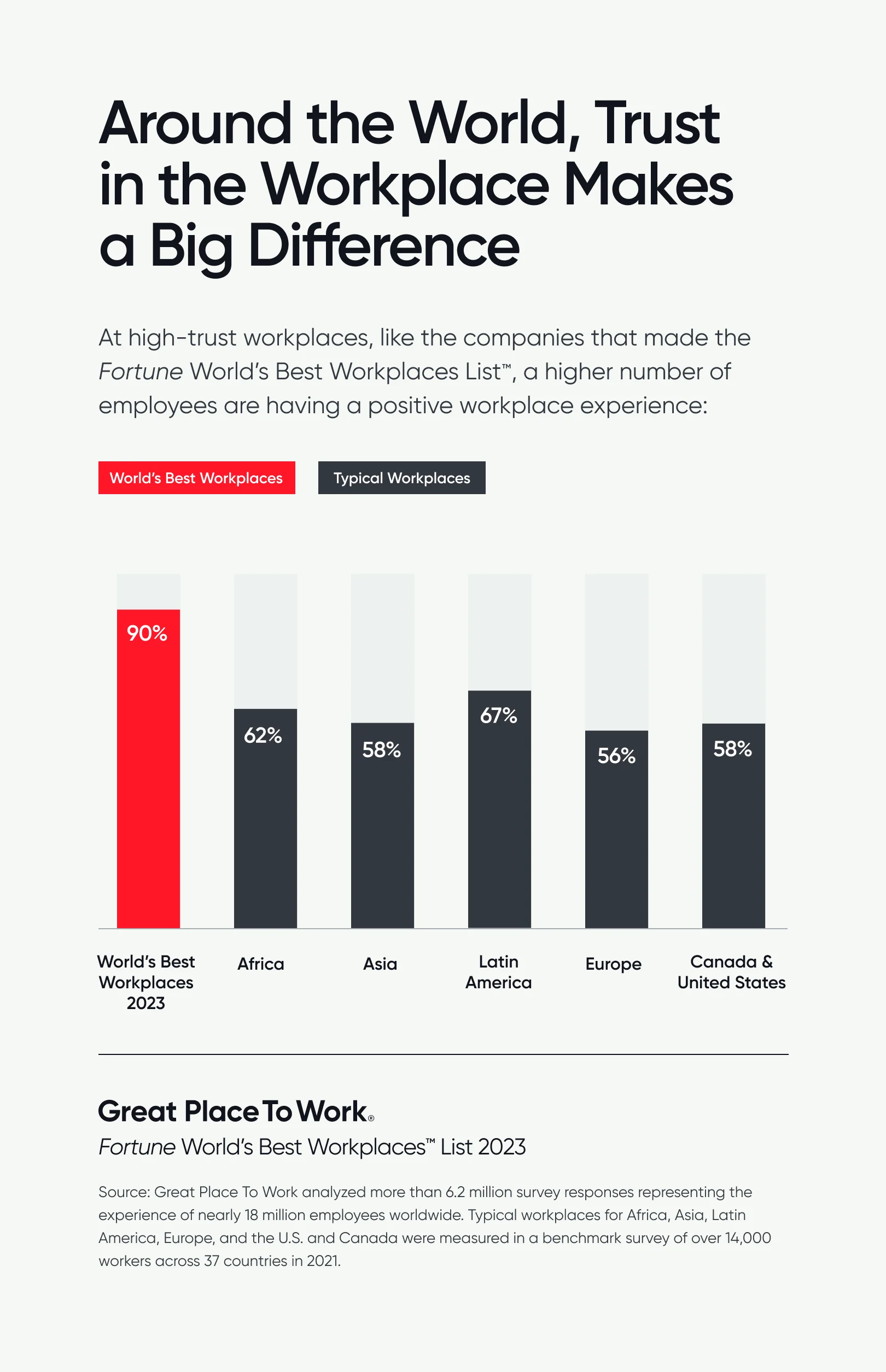
Great Place To Work® analyzed more than 6.2 million survey responses representing the experiences of 18 million workers around the world to find the 25 companies on this year’s World’s Best Workplaces™ List.
These companies easily beat the typical global workplace experience. At winning companies, 90% of employees reported having a great workplace, compared to a little more than half for most regions of the world.
Attend our annual company culture conference May 7-9, 2024
“It doesn’t matter what country or continent you call home,” says Michael C. Bush, CEO of Great Place To Work. “What matters is the trust companies build with their employees. High-trust workplaces listen to all their people, innovate, adapt, measure, and repeat.”
All around the world, having a great workplace is life-changing for employees.
“We have data that proves that some great companies create an experience for underrepresented people that is better than their other experiences in their country,” Bush says. “When businesses create a great place to work and live for all, it is measurably better for the world.”
To be eligible, companies must operate in three or more countries, employ at least 5,000 workers globally with 40% or 5,000 employees outside their headquarters country.
This year’s list was more competitive than ever, with a 28% increase in companies participating in the global survey from 2022, and a 40% increase in the number of surveys received.
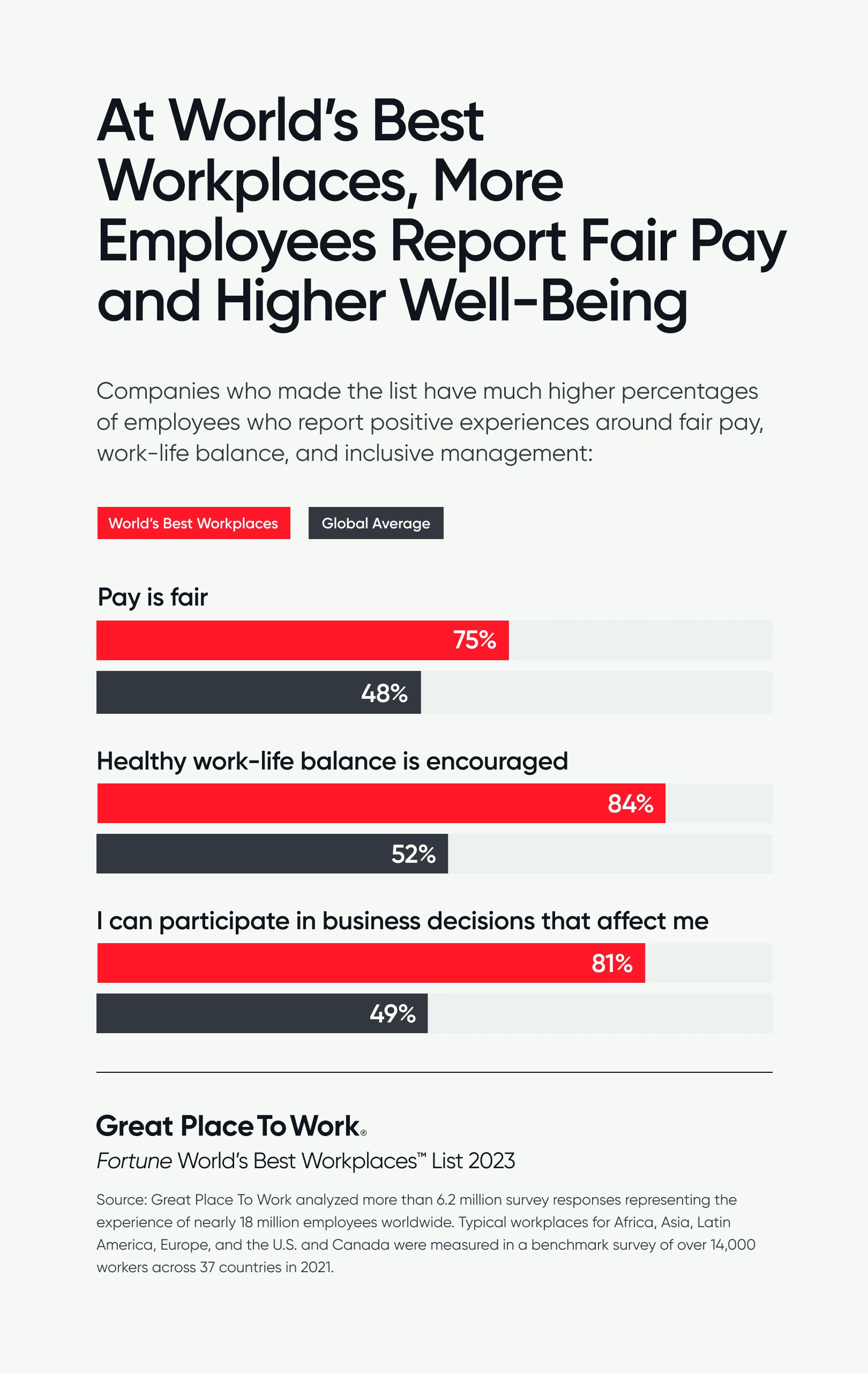
The 25 winning companies had a larger percentage of workers reporting fair pay (75%), healthy work-life balance support (84%), and a voice in decisions that affected their lives (81%), compared to the typical global workplace.
At winning companies, 88% of employees would recommend their employer to friends and family — 34 percentage points higher than the global average of 54%.
What ‘great’ looks like
Here are some of the ways companies on the list are investing in their employees and creating experiences that drive stronger business results:
1. Involve employees in decisions that affect them
Hilton, the new No. 1 on this year’s list, ensures that employees have their voices heard when making decisions that affect them.
In Central and Latin America, Hilton launched “My Voice Matters,” an eight-week listening campaign where leaders received feedback from over 5,000 team members. A commitment to listening is why 84% of Hilton employees say management involves them in decisions that affect them — three percentage points higher than the average for all winning companies.
2. Ensure every employee has a fair, engaged manager
At the World’s Best Workplaces, 79% of employees say their manager doesn’t “play favorites” — and at Cadence, No. 9 on the list, it’s 86%. To accomplish this, Cadence has 90% of its managers around the world complete unconscious bias and allyship trainings.
Cadence’s focus on developing its managers is epitomized by its mentorship program, which came out of work with its employee resource groups (ERGs). By supporting both mentors and mentees, the company is able to build deep trust between workers and management.
3. Encourage every employee to find a healthy work-life balance
At Atlassian, No. 16 on this year’s list, 94% of employees say they are encouraged to find a healthy work-life balance, 10 percentage points higher than the average across winning workplaces.
One of the extraordinary things Atlassian offers is a distributed-first work environment. Employees are not required to work from an office and can spend 90 days a year working away from their permanent work location. Teams are oriented around time zones, with team members maintaining an overlap of at least four hours each workday to support collaboration.
Remote work isn’t a panacea for the employee experience, but the way Atlassian enables remote teams offers a level of flexibility that its team members value deeply.
4. Connect every employee to meaningful work.
At the DHL Express, No. 2 on the list, 90% of employees report feeling that their work is more than “just a job.”
That’s in part due to company efforts to support the communities where it operates, spending 1% of net profit each year giving back. Some examples of this commitment are how DHL helps refugees find a new start with the company, or efforts to shrink its climate footprint.
To ensure every employee feels connected to the company mission, countries are asked to cascade information and engage employees around the question of purpose. For example, in the Americas, employees were asked to upload their own personal purpose to start a conversation around how every employee contributed to the big picture goals for the organisation.
Get recognized
Learn more about these winners and how to earn certification to make a Best Workplaces™ list.